
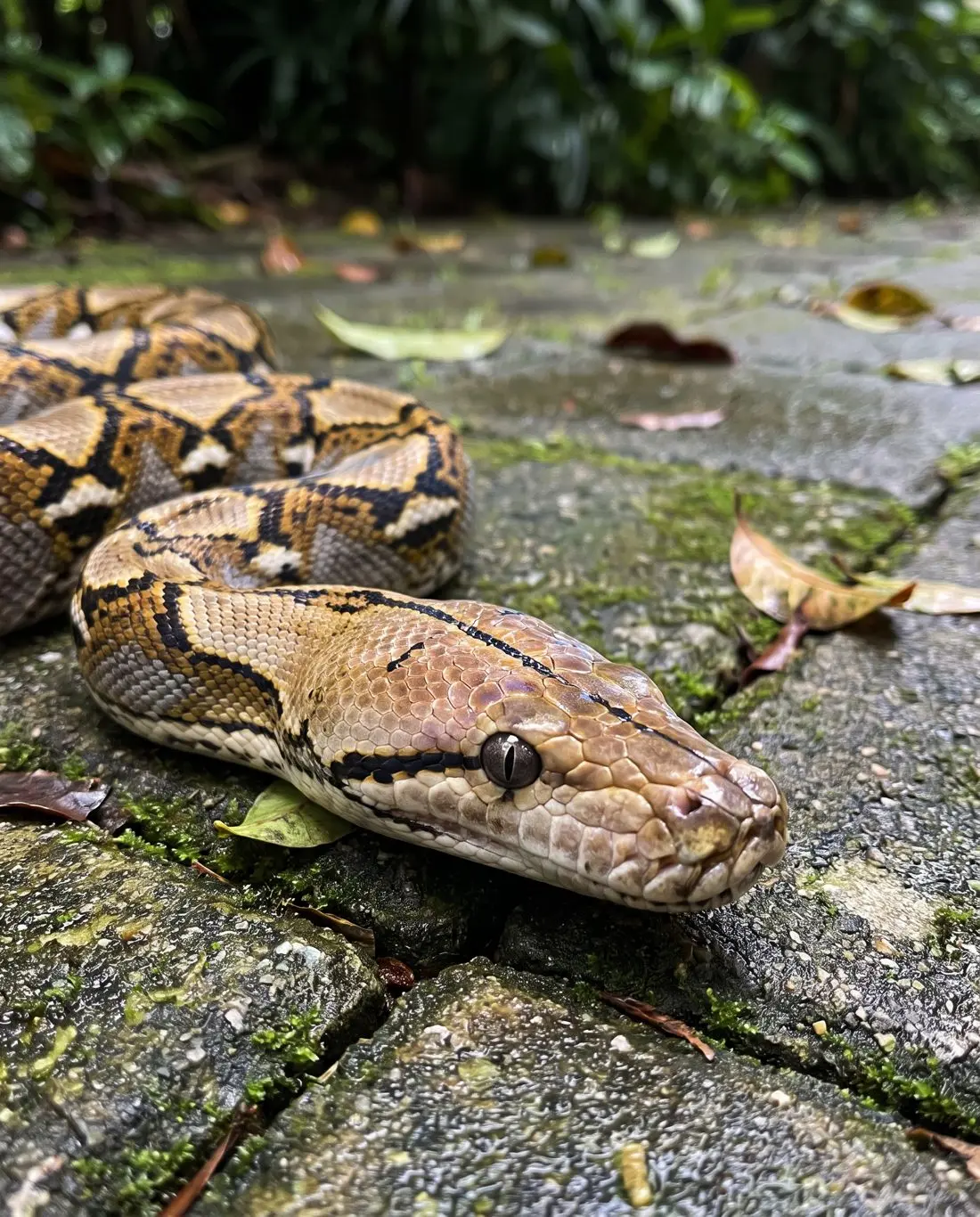
The reticulated python is the longest snake in the world and one of the most common large snakes in Singapore. It lives quietly in forests, canals and drains, where it hunts rats and other mammals. It has no venom and kills its prey by squeezing.
How to recognise it
This is a thick, heavy snake. Its back has a net-like pattern of black zigzag lines around gold, brown and grey patches, often with small white marks along the sides. "Reticulatus" means net-like.
The head is long and pale gold to brown, with a thin dark line down the middle and a black line running back from each eye. The eyes are orange with vertical pupils. Rows of heat-sensing pits along the lips let it find warm-blooded prey in the dark.
Size
Most pythons seen in Singapore today are 2 to 4 m long. Recent data suggests few grow much beyond that here now. The largest ever recorded in Singapore was a 6.7 m museum specimen, noted in 1908. Elsewhere, the longest scientifically measured python was about 7 m, and older reports claim close to 10 m. No other snake grows longer.
Where it lives in Singapore
It is native and found island-wide, from nature reserves and mangroves to the middle of housing estates. It travels along canals, monsoon drains and storm pipes, and often rests in culverts. It swims very well and will slip into water when disturbed.
Pythons in Singapore have also turned up in toilets, on major roads and even inside cars. After a big meal, a python can go weeks or months without eating, resting somewhere hidden while it digests.
What it eats
It mainly eats mammals. In Singapore's towns, rats are a major food, which is why pythons turn up wherever rats are common. Pythons here have also been recorded eating cats and at least one dog, and in 2025 one was seen eating a colugo in forest at Mandai. It also takes birds. Elsewhere, very large pythons take deer and wild pigs. It waits in ambush, strikes, then coils around the prey and squeezes until it dies.
Life cycle
Females lay about 15 to 80 eggs in a clutch. The mother coils around her eggs to guard them, which is unusual among snakes. The eggs take about 80 to 90 days to hatch. Hatchlings are around 60 to 75 cm long and fend for themselves straight away. King cobras have been recorded eating pythons in Singapore.
Is it dangerous?
It is not venomous. It does have many sharp, backward-curving teeth, and a bite from a large python can cause deep cuts. Left alone, pythons pose little threat to people, and serious attacks on people are very rare. It sits at GIVE SPACE on the danger scale.
Frequently asked questions
Are there pythons in Singapore?
Yes. The reticulated python is native and common across Singapore, including in canals and drains in housing estates.
Is the reticulated python venomous?
No. It has no venom. It kills prey by constriction, which means coiling around it and squeezing.
How big do pythons in Singapore get?
Most are 2 to 4 m. The largest recorded in Singapore was a 6.7 m museum specimen, noted in 1908. Elsewhere the longest measured was about 7 m.
What do pythons in Singapore eat?
Mostly rats in urban areas. They have also been recorded eating cats, birds and, at least once, a dog.
Why are pythons found in drains?
Drains and canals give them cover and water, and rats live there too. Pythons use them to move around the island.
More snakes in Singapore
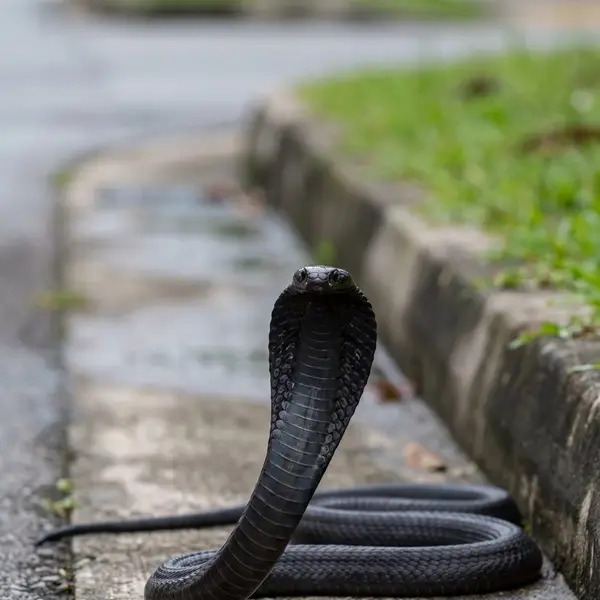 Equatorial spitting cobraNaja sumatranaDANGEROUS
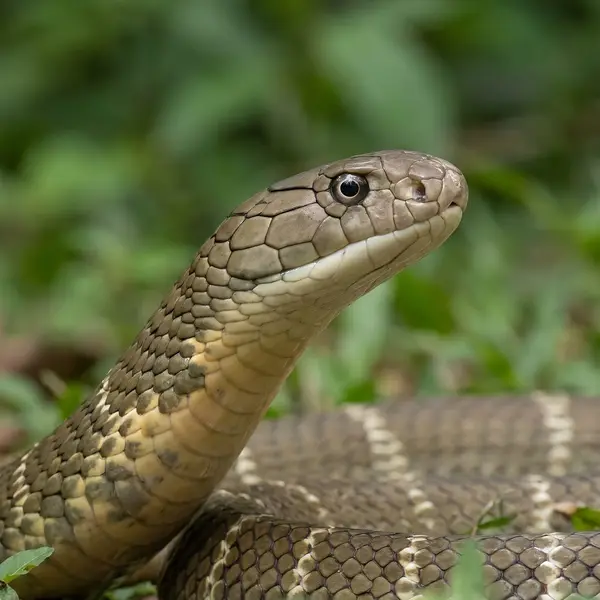 King cobraOphiophagus bungarusDANGEROUS
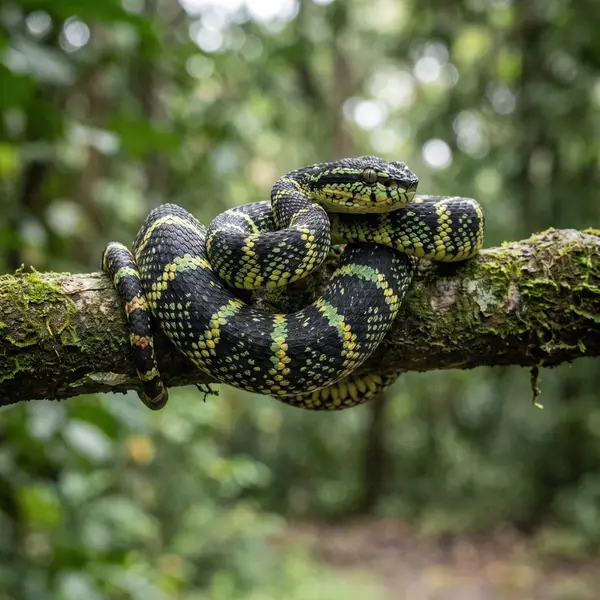 Wagler's pit viperTropidolaemus wagleriDANGEROUS
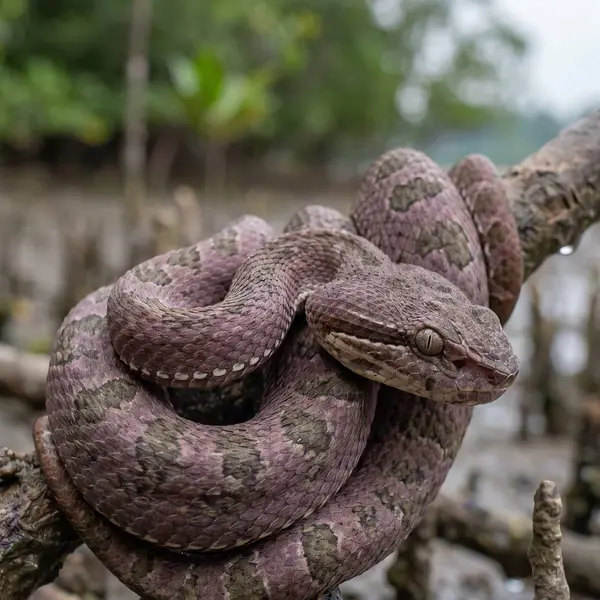 Shore pit viperTrimeresurus purpureomaculatusDANGEROUS
- Banded kraitBungarus fasciatusDANGEROUS
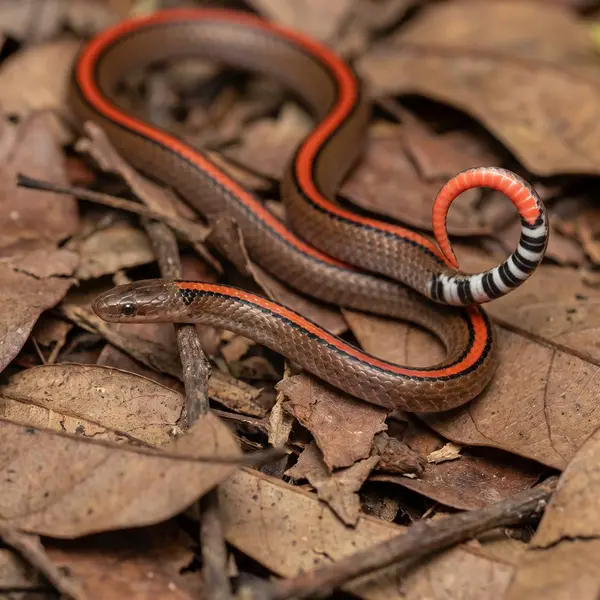 Banded Malayan coral snakeCalliophis intestinalisDANGEROUS
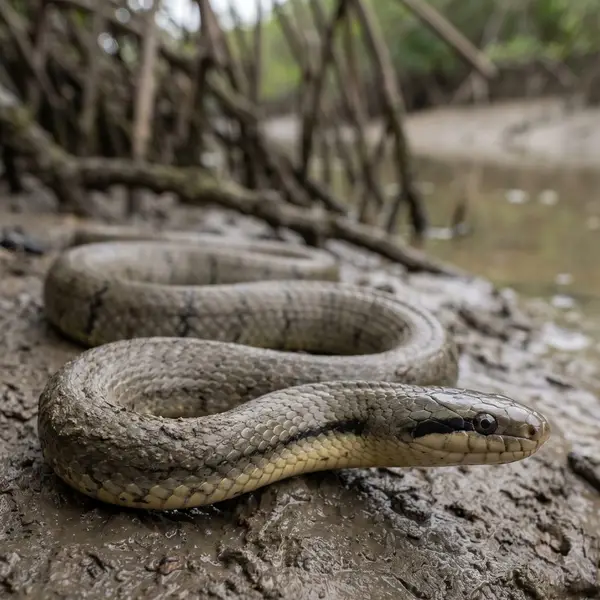 Dog-faced water snakeCerberus schneideriiGIVE SPACE
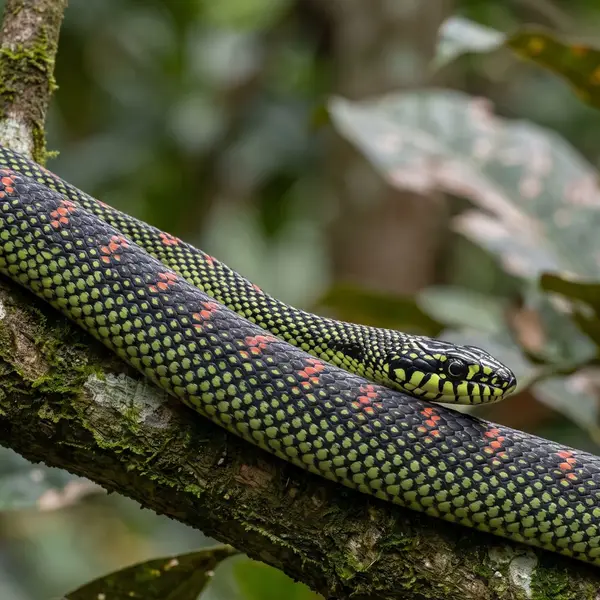 Paradise tree snakeChrysopelea paradisiGIVE SPACE
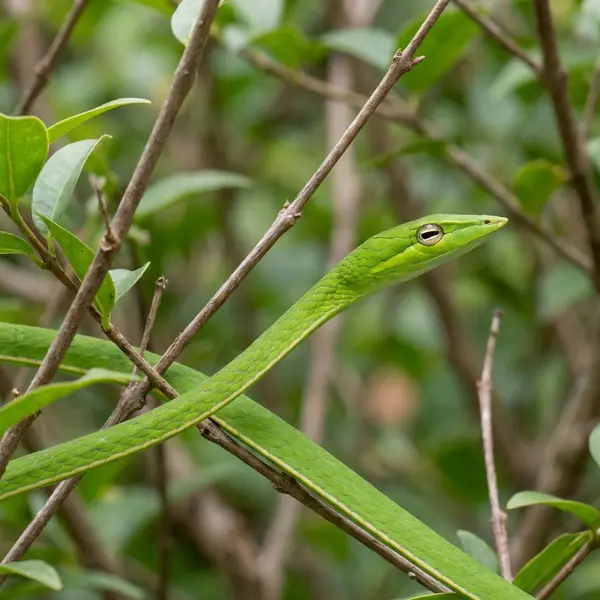 Oriental whip snakeAhaetulla prasinaGIVE SPACE
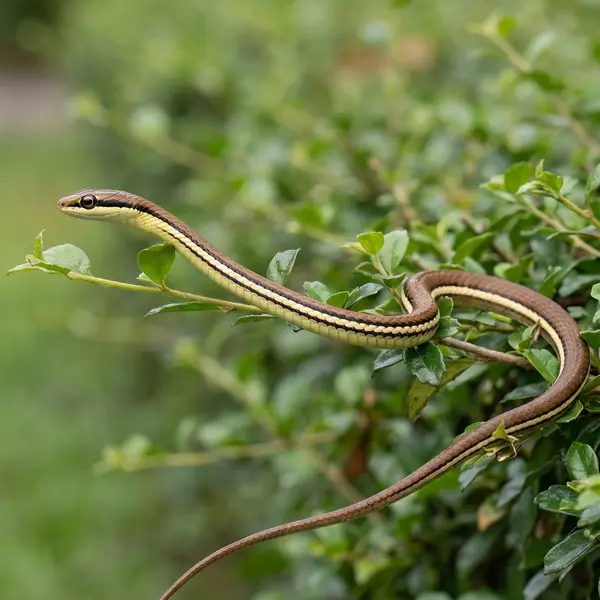 Painted bronzebackDendrelaphis pictusGIVE SPACE
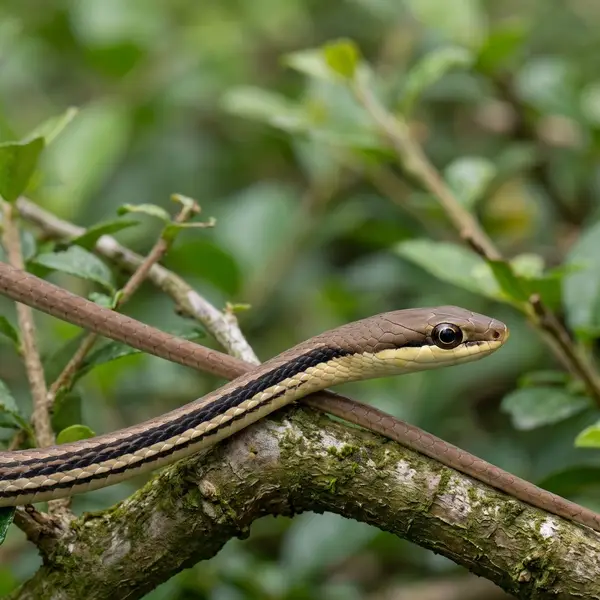 Striped bronzebackDendrelaphis caudolineatusGIVE SPACE
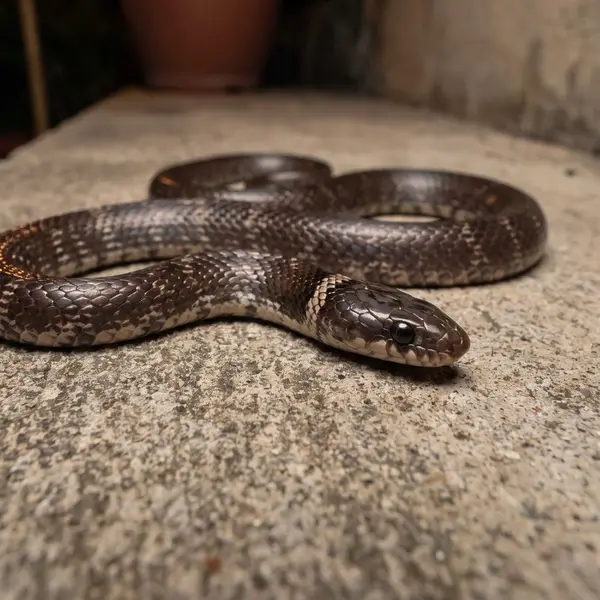 Common wolf snakeLycodon capucinusGIVE SPACE
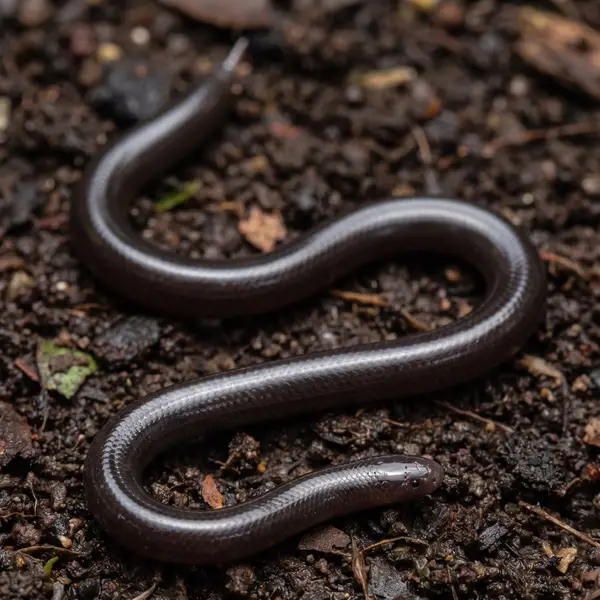 Brahminy blind snakeIndotyphlops braminusHARMLESS