
Why snakes turn up after heavy rain
When drains and burrows flood in the wettest months, snakes move somewhere dry, and this notice tells residents what to do when one turns up in a void deck, riser room or carpark.
Final content check in progress.
Free resources
Download our free snake booklet and notice-board flyers: which snakes in Singapore are venomous, what to do when you see one, how to keep them out of your home, and snakebite first aid. Free to print and pin up. No sign-up needed.


Wildlife Series No. 1
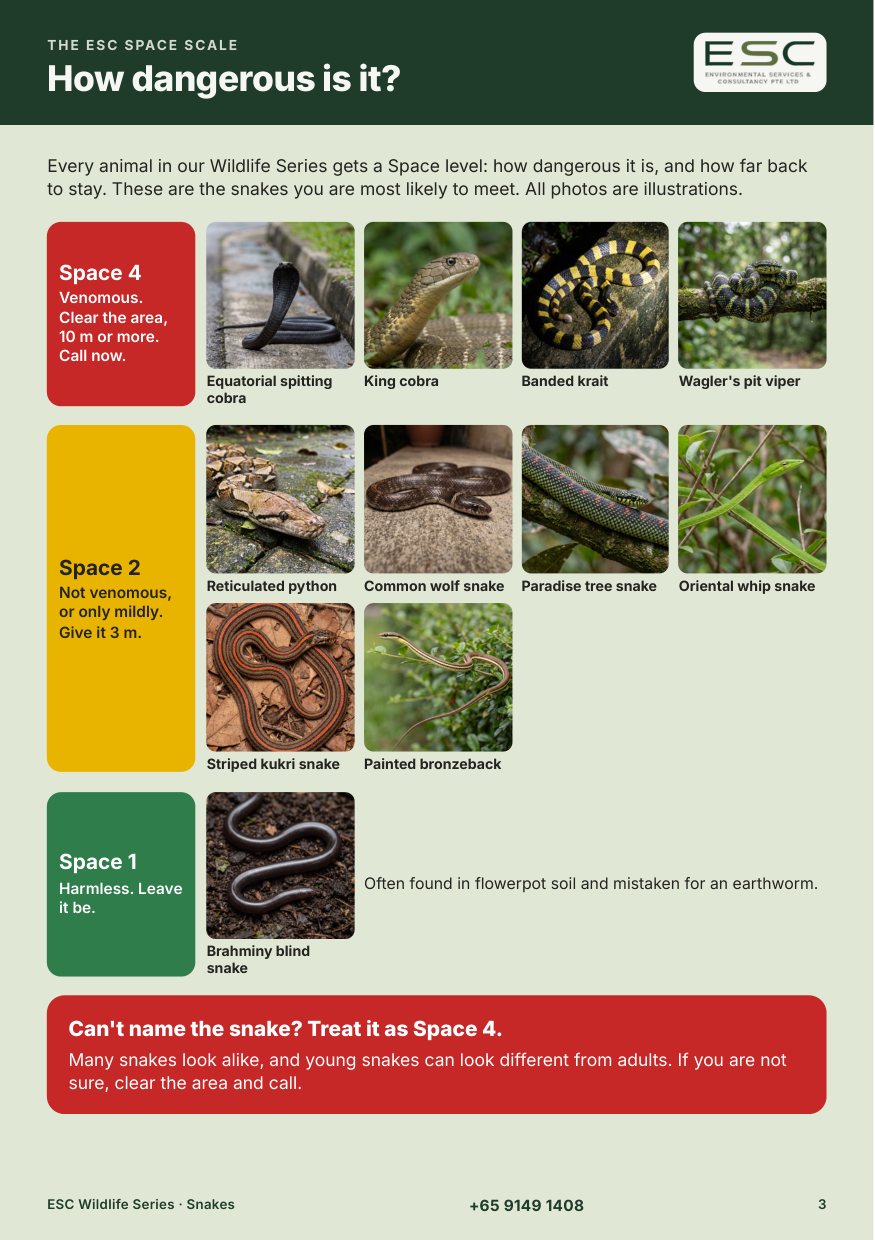
Who's who, how dangerous each snake is, and what to do when you meet one at home or around the estate. Covers the spitting cobra, python, krait, pit viper and seven more, with first aid and snake myths.
Want more detail? Read our full guide: snake in the house, what to do in Singapore
PDF, 12 A5 pages, 3.6 MB · October 2026 edition · Images are illustrations for education only.
Free updates
New animal booklets and monthly notice-board flyers are on the way. Get each one in your inbox the day it's posted, ready to print.
Download the booklet to read and share, or the notice-board version to pin up.
The notice-board version prints one page per A4 sheet. For a booklet, print the "print as booklet" file double-sided (flip on short edge), fold and staple.
Notice board, lift lobby, guardhouse, site office or canteen.
Monthly notice-board flyers · coming soon
Twelve A4 notices following Singapore's seasons and festivals, each covering the wildlife residents are most likely to meet that month. Download links go live as each flyer is signed off.
When drains and burrows flood in the wettest months, snakes move somewhere dry, and this notice tells residents what to do when one turns up in a void deck, riser room or carpark.
Final content check in progress.
Fruit offerings, oranges by the door and open hampers feed macaques, Javan and common mynas, crows and pigeons, so this notice shows how to enjoy Chinese New Year without teaching wildlife where the food is.
Final content check in progress.
Javan and common mynas, pigeons and crows look for nesting cavities from around March, and humane deterrence before eggs are laid is both the kinder and the more effective route.
Final content check in progress.
Stinging-insect activity rises with the April heat, so this notice covers where nests and swarms turn up, how to walk away from them, and when a sting is an emergency.
Final content check in progress.
Water monitors follow pools, ponds and drains in the hottest months, and this notice sets out the poolside rule for residents and staff: give it space and a clear exit.
Final content check in progress.
June puts more children on estate grounds than any other month, and three simple rules cover nearly every wildlife encounter they might have.
Final content check in progress.
Hornet colonies are at their largest in the drier weeks of the Southwest Monsoon, and most stings happen at BBQ pits and gatherings, not in the forest.
Final content check in progress.
Food left at void decks and kerbs during the seventh lunar month is found within hours by birds, macaques and wild boar, so this notice explains how to keep the custom and lose the wildlife problem.
Final content check in progress.
Snake sightings rise when the rains return, and the safest response is also the simplest: stop, back away and call a trained responder.
Final content check in progress.
Inter-monsoon squalls shake nests loose and flood burrows, and a twenty-minute walk-round after each storm keeps the surprises small.
Final content check in progress.
When the heaviest rain of the year fills drains and culverts, snakes and monitor lizards look for somewhere dry, and this notice tells residents and security what to do when one is in the carpark.
Final content check in progress.
Year-end gatherings leave crumbs and open bins across common areas, and this notice explains the five things that stop a pigeon, Javan myna, common myna or crow roost from forming.
Final content check in progress.
Site notice · coming soon
A toolbox-talk notice for the site office: what the crew should do when works disturb snakes, monitor lizards, wild boar or hornet nests, and who to call.
Land clearing, piling and drainage works push snakes, monitor lizards, wild boar and hornet nests into the work zone, and this notice gives the crew the number to call and the do's and don'ts for the toolbox talk.
Final content check in progress.
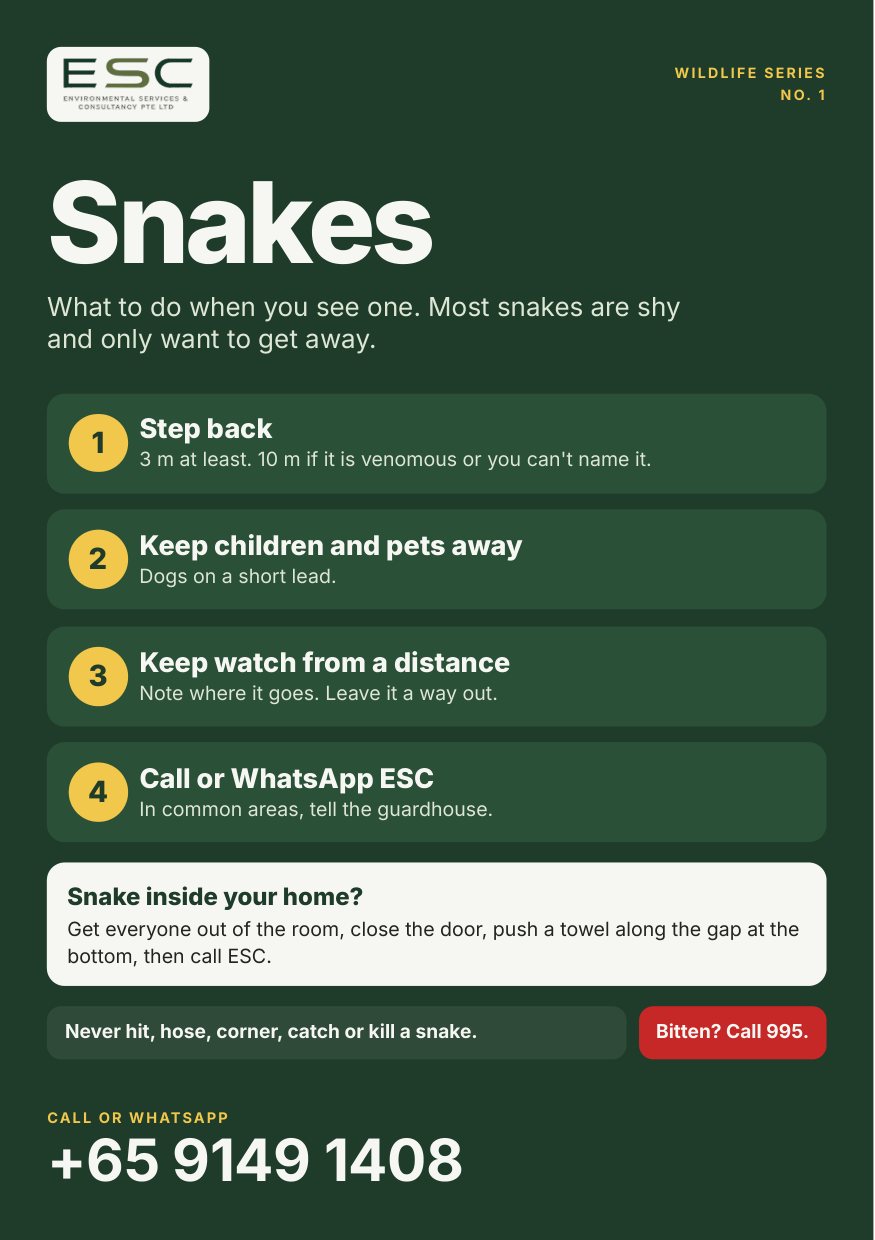
Stop and step back: at least 3 m, or 10 m if it is venomous or you can't name it. Keep children and pets away, have one person watch where it goes from a safe distance, and call or WhatsApp ESC on +65 9149 1408. In a condo common area, tell the guardhouse too. Never try to catch, corner or kill it.
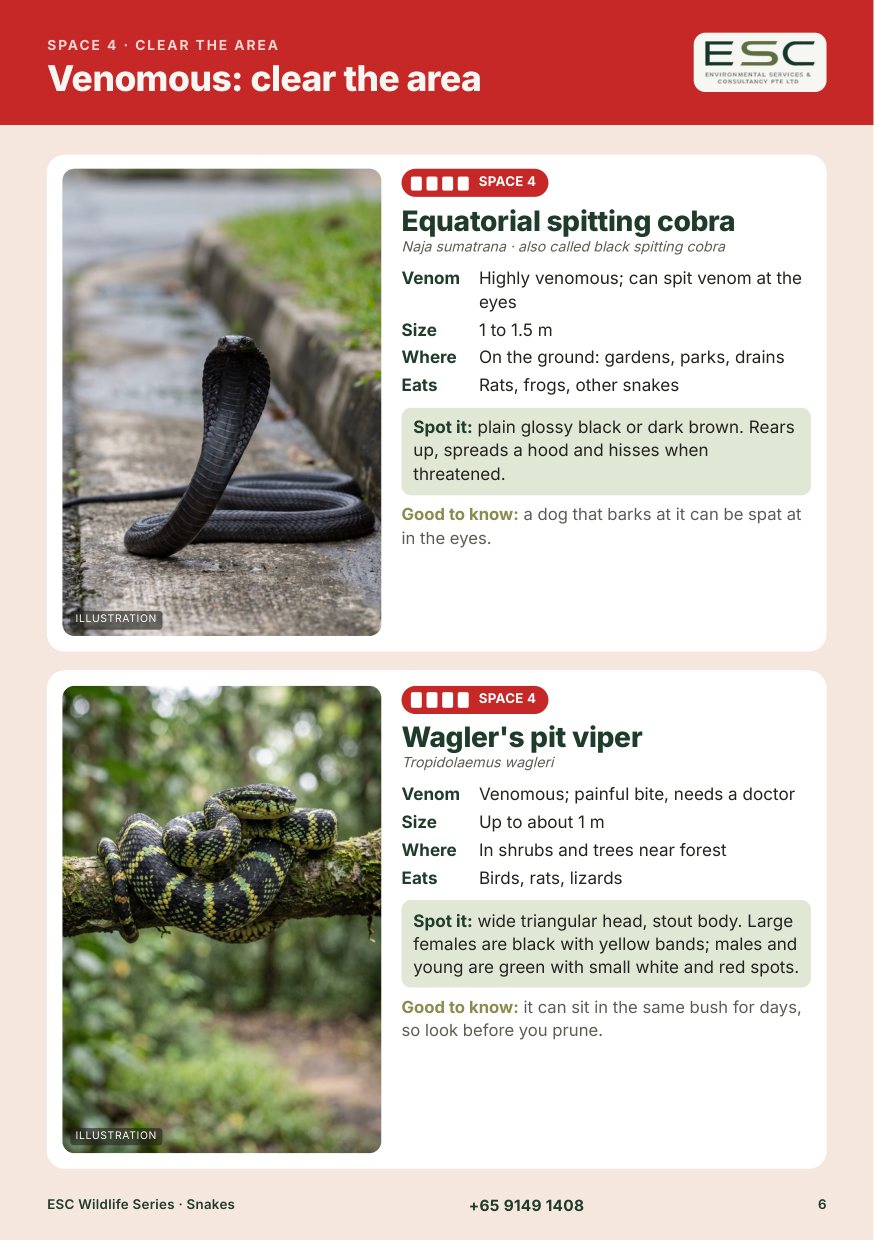
The venomous snakes residents are most likely to meet are the equatorial spitting cobra, the king cobra, the banded krait and Wagler's pit viper. The reticulated python is not venomous but can bite and squeeze, and is a risk to cats and small dogs. If you can't name a snake, treat it as venomous.
Get everyone out of the room, pets too. Close the door and push a towel along the gap at the bottom, then call or WhatsApp ESC. Don't try to sweep or chase it out.
Call 995 straight away. Keep the person still and calm, lying on their side, keep the bitten arm or leg still, and take off rings and tight clothing near the bite. Don't cut or suck the wound, tie anything around the limb, or use ice.
Yes. They are free to print and share. The notice-board version prints one page per A4 sheet for lift lobbies and notice boards, and the print-as-booklet file folds into an A5 booklet.
Every page is fact-checked before it is published.
Environmental Services & Consultancy Pte Ltd80 Genting Lane, #04-10, Singapore 349565UEN: 202627970C
Print as many copies as you need and forward the PDFs to residents, staff or crew.
Talk to us about wildlife management for your estate or site. Contact us or call +65 9149 1408.
Urgent wildlife situation? Call or WhatsApp +65 9149 1408. Other enquiries: we reply within one business day.