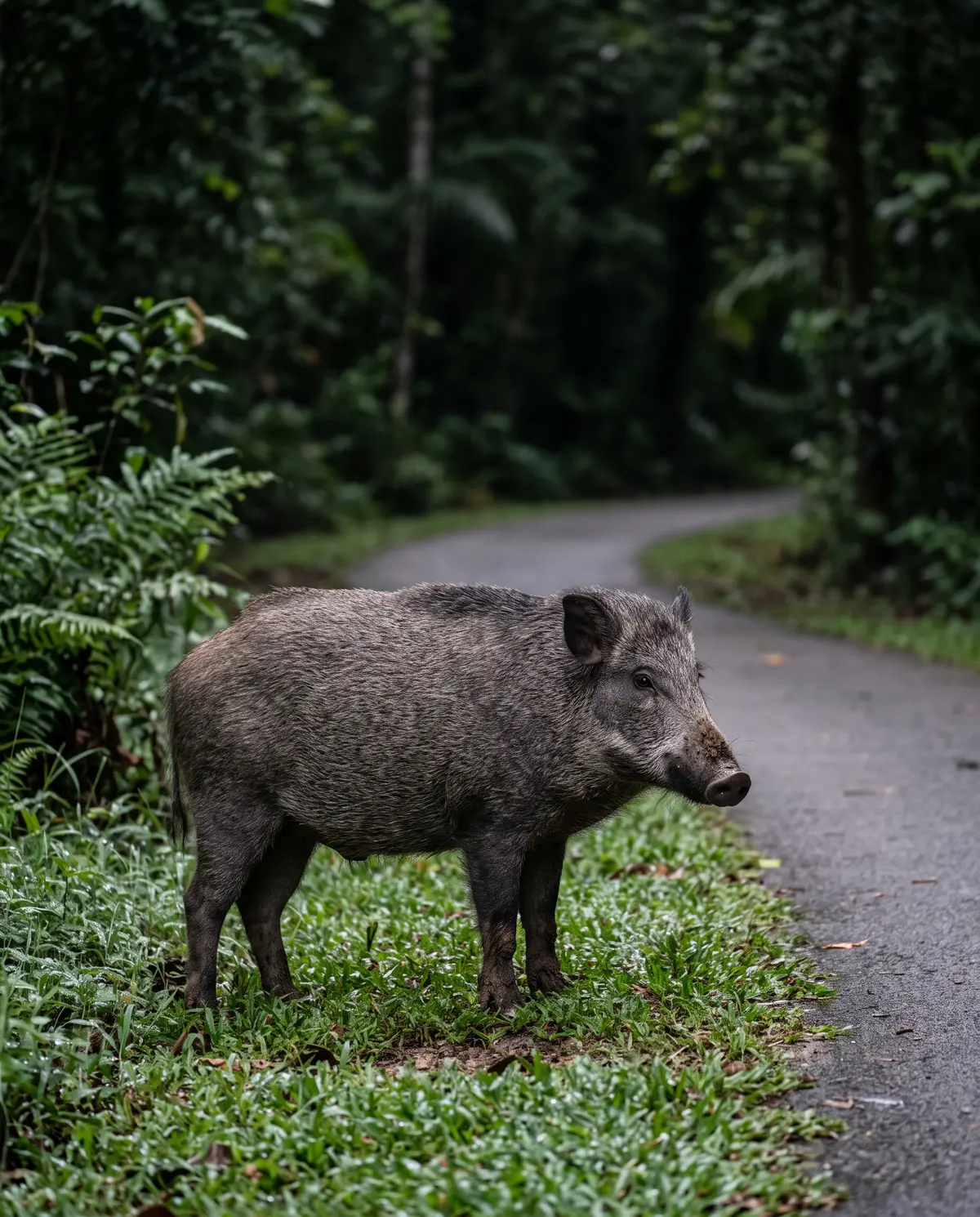
The wild boar is one of Singapore's largest wild land mammals. It was once thought to be gone from the main island, surviving only on Pulau Ubin and Pulau Tekong, but it has since spread back into forests in the north, west and centre. Wild boar are strong, intelligent and usually shy animals that live in family groups.
How to recognise it
A stocky wild pig with a large, wedge-shaped head, long snout, small eyes, upright ears and fairly slim legs. Adults are dark greyish-brown with coarse, bristly hair. The Southeast Asian form found here is smaller than European wild boar, with a sparser coat and a fuller crest of black bristles along the neck and back.
Mature boars have tusks, which are long canine teeth that curve out of the mouth. Adults reach about 1.5 m long and up to about 100 kg. Piglets are brown with pale stripes along the body, which fade over their first few months.
Where it lives in Singapore
Wild boar live in forest, scrubland, grassland and mangroves. In Singapore they are found in the Central Catchment Nature Reserve, especially around Lower Peirce and Nee Soon, in the Western Catchment, on Pulau Ubin and Pulau Tekong, and in wooded land at places such as Lim Chu Kang and Changi. They also turn up in housing areas that border forest.
By the late 20th century the species was thought extinct on Singapore Island. Records on the main island rose sharply from the early 2000s. Researchers believe boar swam across the narrow Johor Strait from Malaysia, or crossed over from Ubin and Tekong. A 2010 estimate suggested the Central Catchment forests alone could hold as many as 552.
What it eats
Wild boar are omnivores, but most of their food is plant matter: seeds, fallen fruit, roots, tubers and young shoots. They also eat earthworms, insects and other small animals, and will scavenge.
They find food mainly by smell and dig for it with their tough snouts, leaving patches of turned-over soil. Researchers think large numbers may damage tree saplings and change how the forest regrows.
Behaviour
Females and their young live together in groups called sounders. Adult males usually live alone and join sounders to mate. A group of up to 15, including young, has been counted in the Lower Peirce area.
Wild boar are active by day and by night. They roll in mud to cool down and to get rid of parasites, and these muddy wallows are a common sign of boar in the forest. Their eyesight is poor but their sense of smell is excellent. They can run fast and are strong swimmers. They are generally shy but unpredictable.
Life cycle
Females can breed from about 18 months old. Pregnancy lasts a little under four months, and before giving birth the sow builds a nest of plant material. Litters usually have about 4 to 6 piglets and can reach 12. A sow can give birth up to twice a year.
Piglets stay with their mother in the sounder, and their stripes fade as they grow. With fast breeding, plenty of food and a lack of natural predators in Singapore, wild boar numbers can rise quickly.
Is it dangerous?
Yes, it can be. ESC rates the wild boar DANGEROUS: keep 10 m or more away. Boar usually avoid people, but they are heavy, strong and unpredictable, and they typically attack when cornered, threatened or startled. Females are very protective of their piglets, and the tusks of adult males can cause deep wounds.
In February 2021, two women were bitten and injured in separate wild boar attacks near Punggol Walk on the same night.
Frequently asked questions
Are wild boar native to Singapore?
Yes. The wild boar is native and is one of Singapore's largest wild land mammals. It nearly disappeared from the main island but has spread back since the early 2000s.
How big do wild boar get in Singapore?
Adults reach about 1.5 m long and up to about 100 kg. The Southeast Asian form found here is smaller and has a sparser coat than European wild boar.
How many piglets does a wild boar have?
Usually about 4 to 6 per litter, and up to 12. Females can start breeding at about 18 months and can give birth up to twice a year.
Why do wild boar piglets have stripes?
Piglets are born brown with pale stripes, which help them blend into the dappled light of the forest floor. The stripes fade over the first few months.
Can wild boar swim?
Yes, they are strong swimmers. Researchers believe this is how wild boar returned to mainland Singapore, crossing the Johor Strait or swimming over from Pulau Ubin and Pulau Tekong.