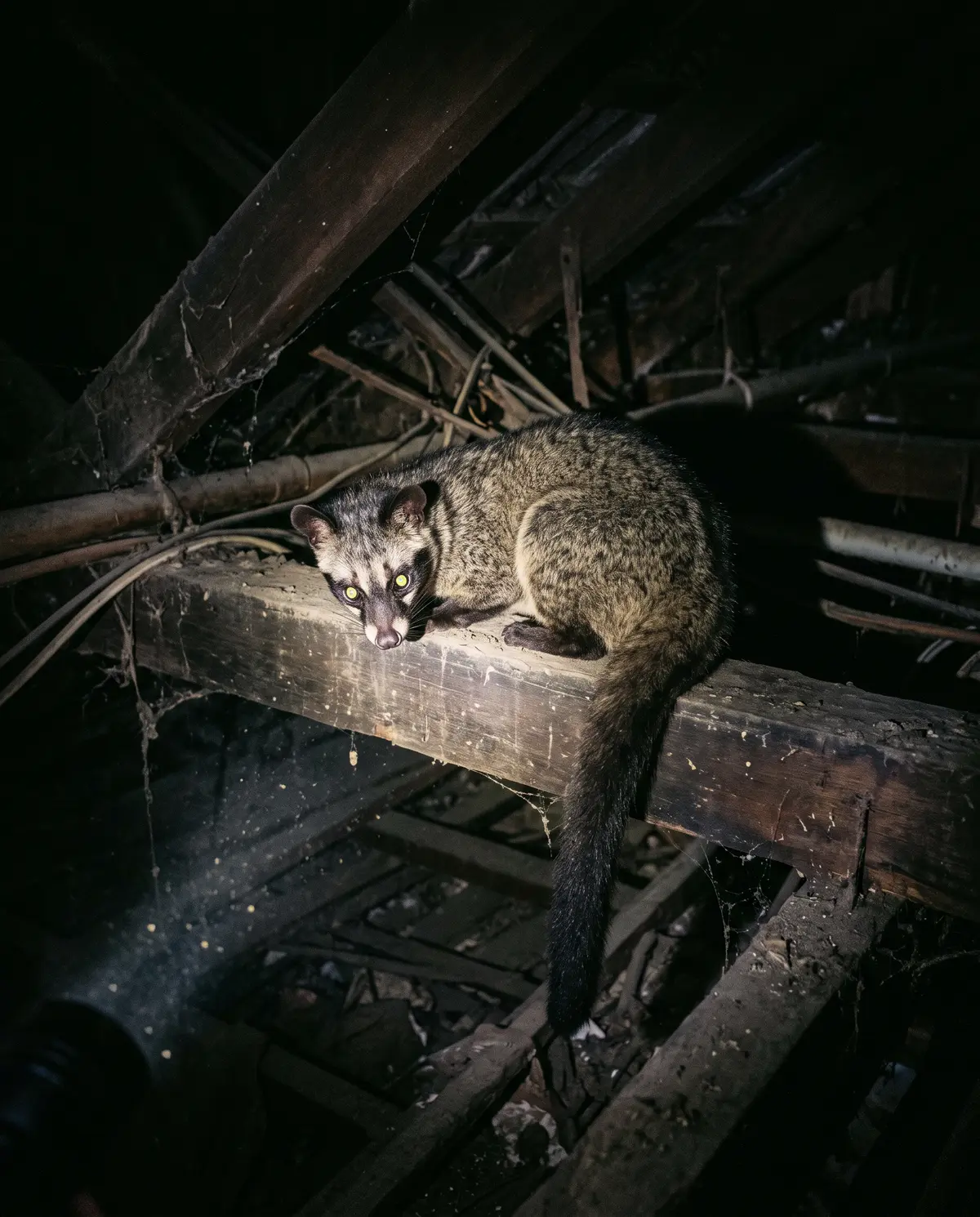
The Sumatran palm civet (Paradoxurus musangus) is the civet you are most likely to see in Singapore. It is a cat-sized, fruit-loving night animal with a dark face mask and a long dark tail. Despite its looks it is not a cat, and it is one of the few wild mammals that lives comfortably among homes.
How to recognise it
The palm civet has a long, low body, short legs and a long tail. Its coat is grizzled grey-brown, with three faint, broken dark stripes along the back and rows of dark spots on the sides.
The face is the best clue. A black mask runs across the eyes and down the muzzle, with whitish patches on the forehead and cheeks. The ears, legs and tail are dark. The tail is about as long as the body and has no rings. Adults weigh about 2 to 5 kg, close to a large house cat.
Where it lives in Singapore
Palm civets are widespread and quite common in Singapore. They live in forest, mangroves, parks and gardens, and in leafy housing areas with tall trees and fruiting palms.
By day a palm civet sleeps somewhere dark and sheltered. In nature this is a tree hollow or a thick crown of palm fronds. In built-up areas it may use roof spaces and false ceilings. At night it travels along branches, roof edges, walls and overhead cables to reach its feeding trees.
What it eats
The palm civet is an omnivore, but fruit makes up most of its diet. In Singapore it often eats the fruits of the fishtail palm, along with figs, mangoes and other soft, ripe fruit. It also takes insects, worms, snails and other small animals, and it has a taste for palm sap.
Many seeds pass through its gut undamaged and can still sprout. Because it drops them far from the parent tree, the palm civet is a useful seed spreader for forest and park trees. The same habit is the origin of kopi luwak coffee in Indonesia.
Behaviour
Palm civets are nocturnal and spend much of their time off the ground. They are skilled climbers and move easily along narrow branches, beams and cables. Adults live alone.
They keep in touch through scent. Both males and females have scent glands under the tail and use them to mark their routes. These glands once confused naturalists, who could not easily tell the sexes apart, and gave the older species name hermaphroditus. Thumps and scurrying in a roof at night are often a palm civet moving between its resting spot and its feeding trees.
Life cycle
Young can be born at any time of year. After a pregnancy of about two months, the female gives birth to two to five young, most often two or three. She chooses a hidden nest such as a tree hollow, a crevice or a quiet roof space.
The mother cares for her young for about three months. They grow up fast: females can breed at about 11 to 12 months old and males at about 9 to 11 months.
Is it dangerous?
No. ESC rates the palm civet HARMLESS: leave it be. It is shy, active at night and avoids people. Like any wild animal, it may bite or scratch if it is cornered, grabbed or trapped.
Singapore has been free of rabies since 1953. Singapore's palm civet is also a different species from the masked palm civet that featured in the SARS story in China.
Frequently asked questions
Is a palm civet a cat?
No. Palm civets belong to their own family, the Viverridae. They are more closely related to mongooses and hyenas than to cats, even though they are about the size of a house cat.
Do palm civets live in roofs?
Sometimes. In nature they rest in tree hollows and thick palm crowns. In leafy estates some use roof spaces and false ceilings as a dry, dark place to sleep by day, and females may raise their young there.
Why is it called Paradoxurus musangus and not Paradoxurus hermaphroditus?
Singapore's palm civets were long listed as Paradoxurus hermaphroditus, the Asian palm civet. A 2015 study of genes and body features split that species into three. The civets found in Singapore are now placed in Paradoxurus musangus.
Do palm civets in Singapore carry rabies?
Singapore has been free of rabies since 1953. A bite or scratch from any wild animal can still become infected.