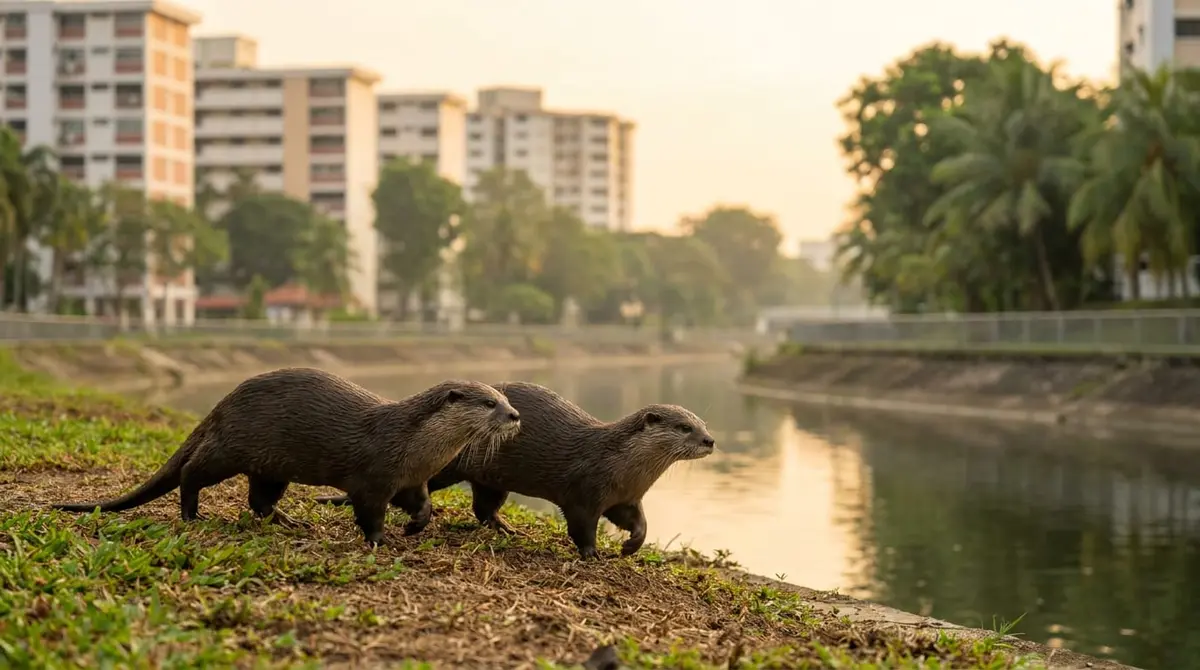
The smooth-coated otter is one of Singapore's best-known wildlife comeback stories. Almost gone from local waters by the 1980s, it returned in the late 1990s and now lives in family groups along coasts, reservoirs and city canals. It is the otter you are most likely to see on the main island.
How to recognise it
A large, sleek otter with short, smooth fur that looks glossy when wet. The back is dark brown to reddish-brown, and the throat and belly are paler. The head is rounded, the bare nose pad is roughly diamond-shaped, and the whiskers are thick.
The tail is thick at the base and flattened towards the tip, which helps with steering. The feet are large and webbed, with strong, sharp claws. Singapore also has the much smaller Asian small-clawed otter, found mainly on Pulau Ubin and Pulau Tekong, and hybrids between the two have been recorded here.
Where it lives in Singapore
Smooth-coated otters use coasts, mangroves, reservoirs, rivers and concrete canals. In Singapore they range from Sungei Buloh in the north to Marina Bay in the south, and inland along waterways such as the Kallang River through Bishan-Ang Mo Kio Park. Some families also visit fish ponds in gardens, condos and commercial sites.
Each family holds a territory along a stretch of water. They rest and raise pups in dens called holts, often tucked under built structures. Otters nearly vanished from Singapore in the 1970s and 1980s, a decline linked to pollution and coastal reclamation. A family settled here in 1998, probably from Peninsular Malaysia, and numbers grew from at least 79 in 2017 to at least 170 in early 2021.
What it eats
Fish make up most of the diet. Smooth-coated otters often hunt together, working as a team in the water. They also eat prawns, crabs and other small water animals, and sometimes frogs or insects.
In Singapore's reservoirs, canals and ponds they eat both native and introduced fish. Introduced tilapia and other cichlids make up much of their catch in reservoirs, and they also take koi from ornamental ponds. Plenty of prey in urban waters has helped the population grow.
Behaviour
Smooth-coated otters live in family groups made up of a breeding pair and their young from several litters. In Singapore, groups range from 2 to 24 animals, among the largest ever recorded for the species. They are mainly active by day, with a rest around midday, and keep in touch with whistles, chirps and squeals.
Neighbouring families defend their stretch of water, and fights between groups have caused some otter deaths in Singapore. Road traffic is the leading recorded cause of death here, mostly on roads that cross or run beside waterways.
Life cycle
Pups are born in a holt after a pregnancy of about 60 to 63 days. In a 2020 to 2021 survey in Singapore, litters averaged about four pups, and the largest had seven.
Pups are born blind and helpless, and their eyes open at about 10 days. Their parents coax them into the water to learn to swim. They are weaned at about three to five months, reach adult size at about one year, and mature at two to three years, when many leave to form families of their own.
Is it dangerous?
ESC rates the smooth-coated otter KEEP CLEAR: give it at least 5 m. Otters are not aggressive by nature and usually move away from people. But they have sharp teeth and a strong bite, and a family will defend its pups and territory.
In November 2021, a man on an early morning walk in the Singapore Botanic Gardens was bitten many times after a group of otters was startled. Dogs that get close to otters are also at risk of being bitten.
Frequently asked questions
How many otters are there in Singapore?
A survey from September 2020 to March 2021 counted at least 170 smooth-coated otters in 17 groups. That was a minimum count, so the true number was likely higher. A newer national census was completed in 2026.
Where did Singapore's otters come from?
Otters nearly disappeared from Singapore in the 1970s and 1980s. A family settled here in 1998, probably arriving from Peninsular Malaysia, and the population has grown since.
Do otters attack people in Singapore?
Rarely. Otters usually avoid people, but they can bite when startled at close range or when guarding pups. In November 2021, a man was bitten many times by a startled otter family in the Singapore Botanic Gardens.
What is the difference between a smooth-coated otter and a small-clawed otter?
The smooth-coated otter is much bigger, at about 7 to 11 kg, with sleek fur and a flattened tail. The Asian small-clawed otter is the world's smallest otter and in Singapore lives mainly on Pulau Ubin and Pulau Tekong.