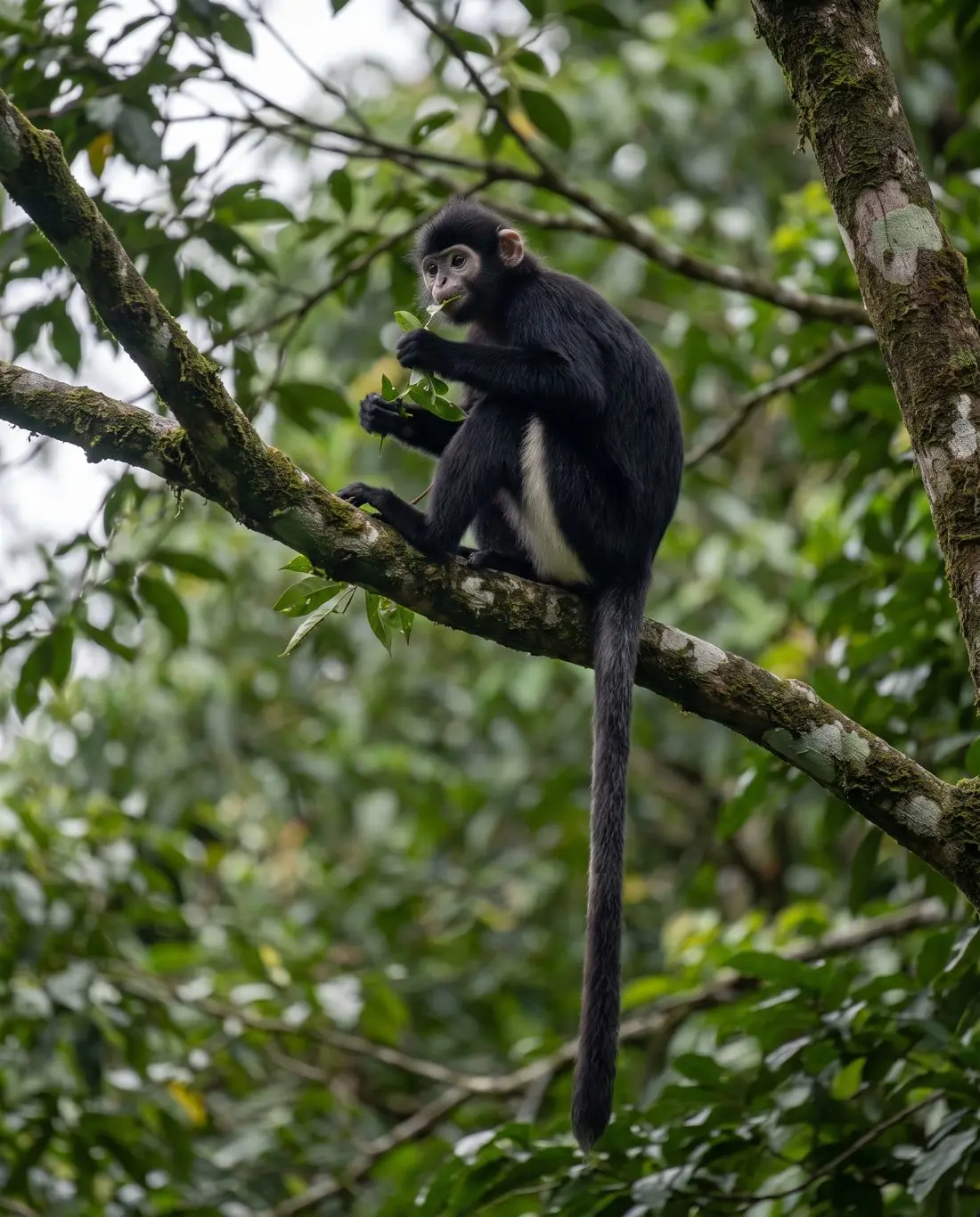
The Raffles' banded langur is Singapore's other wild monkey, and one of the rarest primates in the world. About 80 live here, in the Central Catchment forest, with perhaps a few hundred more in southern Peninsular Malaysia. It is a quiet, plant-eating monkey that spends almost its whole life high in the trees.
How to recognise it
A slim, long-limbed monkey with dark grey to black fur. White fur runs down the chest and belly and along the inner thighs, which gives the banded langur its name. The face is dark, often with paler skin around the eyes and lips. The tail is longer than the head and body, up to about 84 cm.
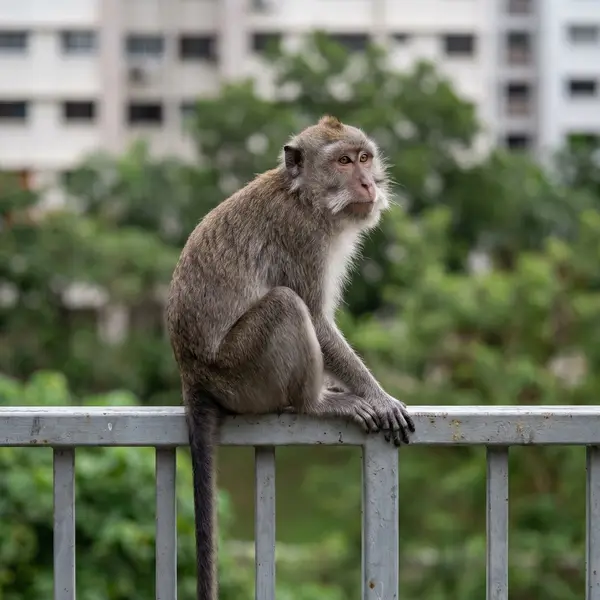
Infants look completely different. They are born white, with a black stripe down the back crossed by another over the shoulders, and darken as they grow. A long-tailed macaque, by contrast, is grey-brown with a pinkish face.
Where it lives in Singapore
This langur is found only in Singapore and southern Peninsular Malaysia. It was once widespread in Singapore's forests, but forest loss cut the population to an estimated 10 to 14 animals by 1990. The last langur in the Bukit Timah Nature Reserve died in 1987, after the Bukit Timah Expressway split that forest from the Central Catchment.
Today Singapore's langurs live in the Central Catchment Nature Reserve, mainly around the Nee Soon Swamp Forest. In 2023 a camera trap recorded a langur on the Eco-Link@BKE wildlife bridge for the first time. In May 2026 an adult male was seen feeding on Bukit Timah summit, the first documented record there in about 40 years.
What it eats
The langur eats almost nothing but plants. It feeds on young leaves, fruits and seeds, often unripe, along with some flowers. In Singapore it has been recorded feeding on at least 27 plant species.
Special gut bacteria help it break down tough leaves and unripe fruit. Unlike the long-tailed macaque, it usually destroys the seeds it eats, so it does little to spread them.
Behaviour
Langurs are active by day, mostly in the morning and late afternoon. They live in small groups, usually one adult male with several females and their young. In 2021, Singapore's groups averaged about six animals, and the largest had 13.
They move by walking on all fours along branches and leaping between trees. They come down to the ground mainly to cross gaps or pick up fallen fruit, so unbroken tree cover matters a great deal to them. Their alarm call is a harsh rattle followed by repeated chak sounds.
Life cycle
A female gives birth to a single infant, and births are thought to be about two years apart. Young males leave their birth group at about four years old. One generation takes about 10 to 12 years, so the population can only grow slowly.
Even so, Singapore's langurs are recovering. Numbers rose from about 40 in 2010 to 68 in 2021 and about 80 in 2026. The main limit on further growth is the amount of connected forest available.
Is it dangerous?
No. ESC rates the Raffles' banded langur HARMLESS: leave it be. It is shy, stays high in the canopy and moves away from people. Most visitors to the nature reserves never see one.
The real danger runs the other way. Langurs that come down to cross between forest patches risk being hit by traffic, and one was killed on the Bukit Timah Expressway in 2017.
Frequently asked questions
How many Raffles' banded langurs are left in Singapore?
About 80, as of 2026. That is roughly double the 40 or so counted in 2010, but the species is still Critically Endangered.
Where do Raffles' banded langurs live in Singapore?
In the Central Catchment Nature Reserve, mainly around the Nee Soon Swamp Forest. Single langurs have recently been recorded on the Eco-Link@BKE and at Bukit Timah.
What do baby langurs look like?
They are born white, with a black stripe running down the back and another across the shoulders, which makes a cross shape. They darken to the adult black and white colouring as they grow.
Is the banded langur a type of macaque?
No. Both are Old World monkeys, but the langur is a leaf monkey in a different group. It is black and white, eats almost only plants, and rarely leaves the treetops, while the long-tailed macaque is grey-brown and eats almost anything.