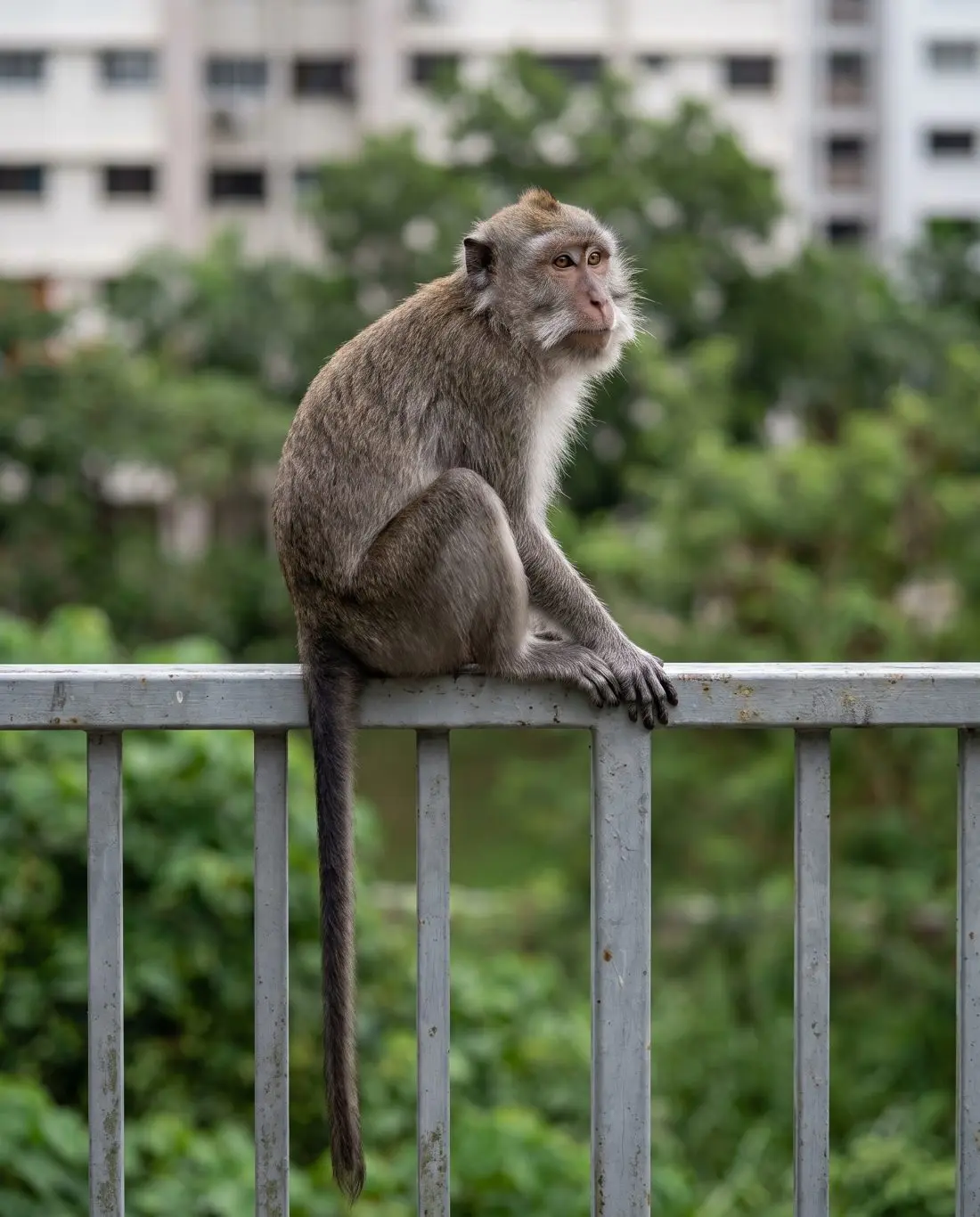
The long-tailed macaque is the monkey most people in Singapore will meet. It lives in troops in and around the nature reserves and often wanders into parks and estates at the forest edge. Its other name, crab-eating macaque, comes from its habit of hunting crabs along mangroves and shores.
How to recognise it
A grey-brown monkey with a paler belly and a tail roughly as long as its head and body. Adults have grey-white whiskers framing a pinkish-brown face. The eyelids are pale, almost white, and show clearly when the monkey raises its eyebrows.
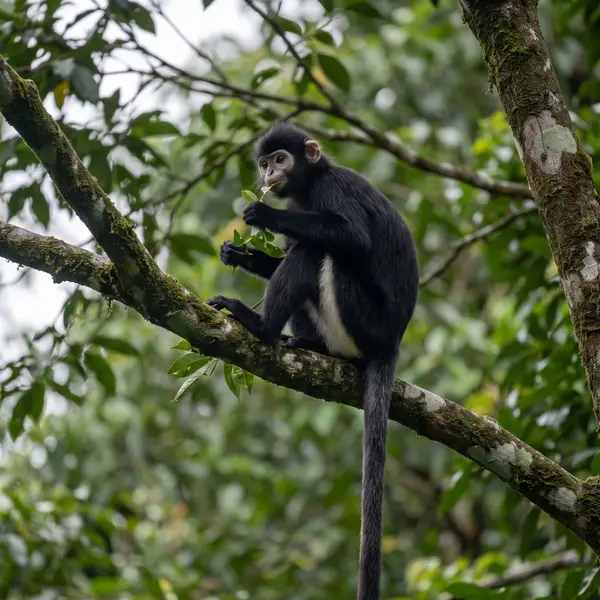
Males are noticeably bigger than females and have long canine teeth. Babies are born with black fur and a pink face, and turn grey-brown at about three months old. Singapore has only one other wild monkey, the Raffles' banded langur, which is black and white and keeps to the tall forest.
Where it lives in Singapore
A 2009 study estimated about 1,200 to 1,450 long-tailed macaques in Singapore. Roughly 70 percent lived in the Central Catchment and Bukit Timah nature reserves. The rest lived in smaller forest patches across the main island and on five offshore islands.
Troops whose home ranges border housing estates, condos, parks and golf courses often travel along the forest edge and into these areas. They are strong climbers and can move easily across roofs, railings and balconies.
What it eats
Fruit is the main food, often making up 40 to over 80 percent of the diet in wild troops. Macaques also eat young leaves, flowers, seeds, insects and small animals. Along mangroves and shores they search for crabs, which gave the species its other name.
A macaque can stuff food into its cheek pouches and eat it later somewhere safe. It spits out larger seeds as it goes, which helps spread forest plants. Troops near people also eat human food, and a Singapore study found that troops fed by people were larger on average.
Behaviour
Long-tailed macaques live in troops with several adult males, more adult females, and their young. In Singapore, troops range from a few animals to more than 60, and troops living close to people tend to be bigger. Females stay in the troop they were born into for life and form ranked family lines. Males leave as they grow up and join other troops.
They are active by day, sleep in tall trees at night, and swim well. Faces carry a lot of meaning. A hard stare with raised eyebrows is a warning, and an open-mouthed stare is a threat. A wide grin showing the teeth signals fear, not friendliness.
Life cycle
A female usually gives birth to a single baby after a pregnancy of about five and a half to six months. The newborn weighs about 320 g and clings to its mother's belly, riding with her for months while it learns what to eat and how the troop works.
Its black baby coat changes to grey-brown at about three months. Young females stay in their mother's troop. Young males leave before they are about seven years old.
Is it dangerous?
ESC rates the long-tailed macaque KEEP CLEAR: give it at least 5 m. Most macaques avoid trouble, but they can bite or scratch when cornered, threatened, guarding a baby, or when they are used to getting food from people. Bold macaques may grab bags they link with food.
Bites and scratches can become infected. Macaques can also carry herpes B virus, though human cases are very rare and have mostly involved laboratory workers.
Frequently asked questions
How many kinds of monkey live wild in Singapore?
Two: the long-tailed macaque and the Raffles' banded langur. The southern pig-tailed macaque is sometimes seen, but it is not wild here. Those animals are escaped pets.
How many long-tailed macaques are there in Singapore?
A 2009 study estimated about 1,200 to 1,450. Most live in the Central Catchment and Bukit Timah nature reserves, with smaller groups in forest patches and on offshore islands.
Why is it called the crab-eating macaque?
Along mangroves and shores it forages for crabs and other small animals. Fruit is still its main food.
Why do macaques bare their teeth?
A wide grin with the teeth showing is a sign of fear or submission, not a smile. An open-mouthed stare is different: that is a threat.