The Javan myna is the most common bird in Singapore. This dark grey, yellow-billed bird is everywhere, from hawker centres to bus stops. Yet in its homeland on Java and Bali it is listed as Vulnerable, because so many have been trapped for the cage-bird trade.
How to recognise it
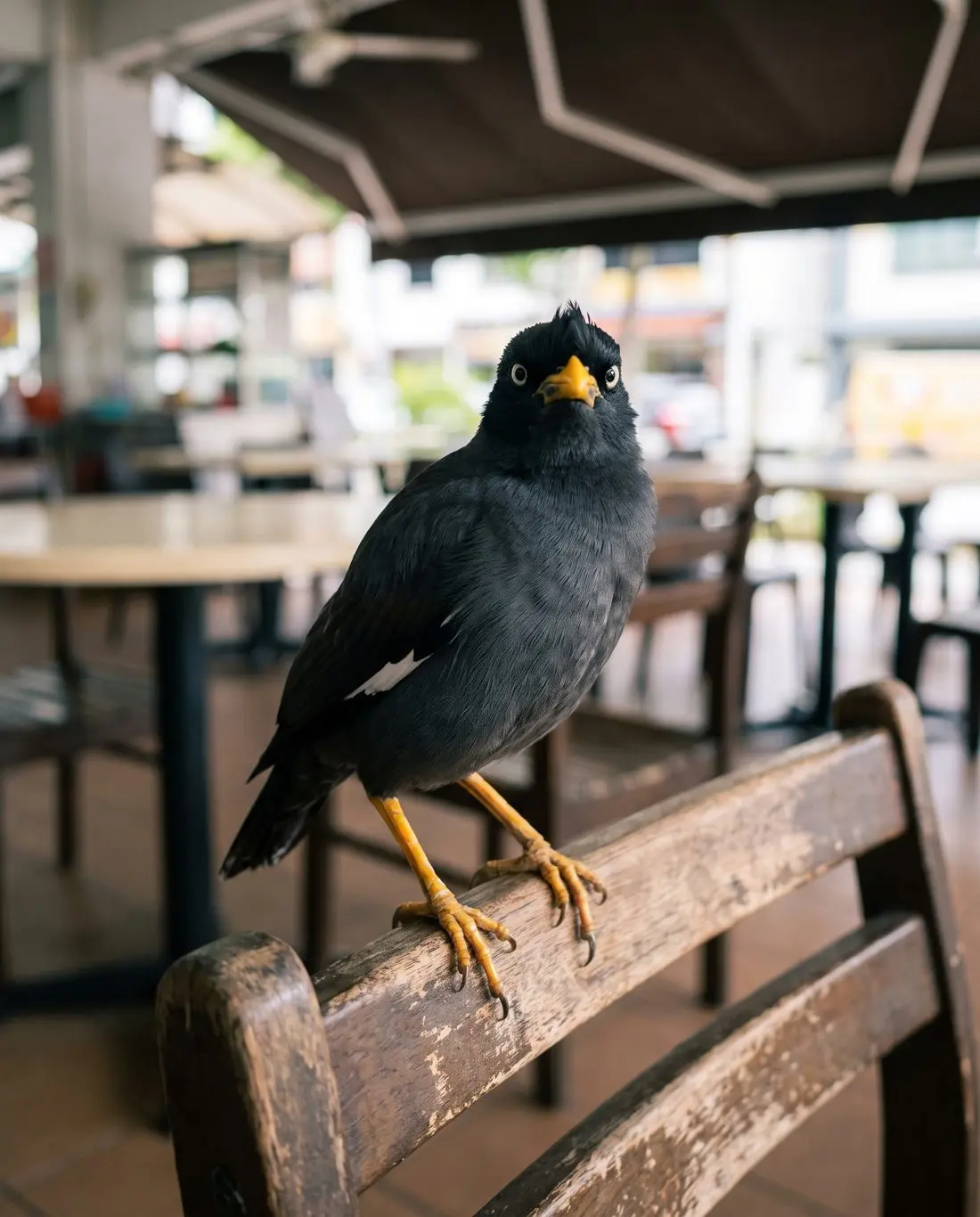
It is a stocky, dark grey to black bird, 21 to 25 cm long, with an orange-yellow bill and legs and pale lemon-yellow eyes. A short tuft of feathers sticks up on the forehead. In flight it shows white patches at the base of the wings. The feathers under the tail are white, which is why it is also called the white-vented myna.
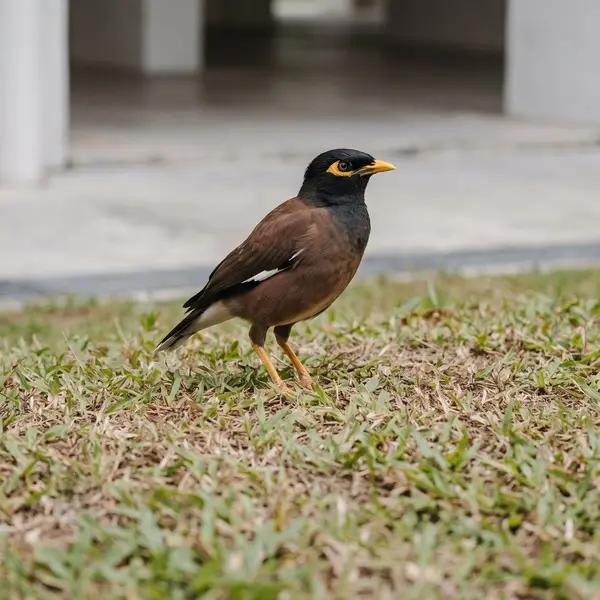
It has no bare yellow skin around the eye, which sets it apart from the brown common myna. Young birds are browner and duller, with a shorter tuft.
Where it lives in Singapore
Javan mynas live wherever people do: housing estates, town centres, hawker centres, roadsides, parks and fields. They nest in holes and gaps in buildings, eaves, signboards, roof spaces and trees.
The oldest Singapore specimen was collected in Katong in July 1920, and the birds were probably brought in from Java through the cage-bird trade. By 2000 to 2001 there were an estimated 122,000 to 155,000 Javan mynas in Singapore. In a 2010 to 2011 survey of Singapore's urban areas, it was the most numerous bird.
What it eats
It is an omnivore. It walks on lawns and fields picking up insects and other small animals, and also eats seeds, fruit and food scraps. It feeds mostly on the ground and sometimes in trees.
Behaviour
Javan mynas are usually seen in pairs or small groups by day. At dusk they gather in large, noisy communal roosts in leafy trees along roads and in town centres. Studies in Singapore found angsana and sea apple trees among their favourite roost sites. They are bold birds and can mimic other sounds.
Because they nest in holes, Javan mynas are thought to compete with native birds that use the same kind of nest site. This may be one reason the oriental magpie-robin became rare in Singapore.
Life cycle
A pair lays 2 to 5 blue eggs in a hole or gap. The eggs hatch in about two weeks, and the young leave the nest at around 25 days old.
Common here, threatened at home
On the IUCN Red List the Javan myna is Vulnerable. Heavy trapping for the cage-bird trade has caused a rapid decline in Java and Bali, and the once-common bird is now rarely seen in the wild there. BirdLife International estimates there may be fewer than 10,000 mature birds left in its native range, though this figure is uncertain. The introduced populations in places like Singapore are far larger.
The Javan myna is rated HARMLESS. It does not attack people and has no venom.
Frequently asked questions
Is the Javan myna native to Singapore?
No. It is native to Java and Bali in Indonesia. The oldest Singapore specimen dates from 1920, and the birds were probably brought in through the cage-bird trade. It is now Singapore's most common bird.
Why is the Javan myna listed as Vulnerable if it is so common here?
Its global status reflects its native range. In Java and Bali, heavy trapping for the cage-bird trade has caused a rapid decline, so the IUCN lists it as Vulnerable. Introduced populations elsewhere are much larger.
How do you tell a Javan myna from a common myna?
The Javan myna is dark grey to black with a small tuft on the forehead and no bare skin around the eye. The common myna is brown with a black head and a bright yellow patch of bare skin behind the eye.
Why do mynas gather in trees at dusk?
Javan mynas sleep together in communal roosts. Large groups gather in leafy trees in the evening, which makes the trees very noisy around sunset.