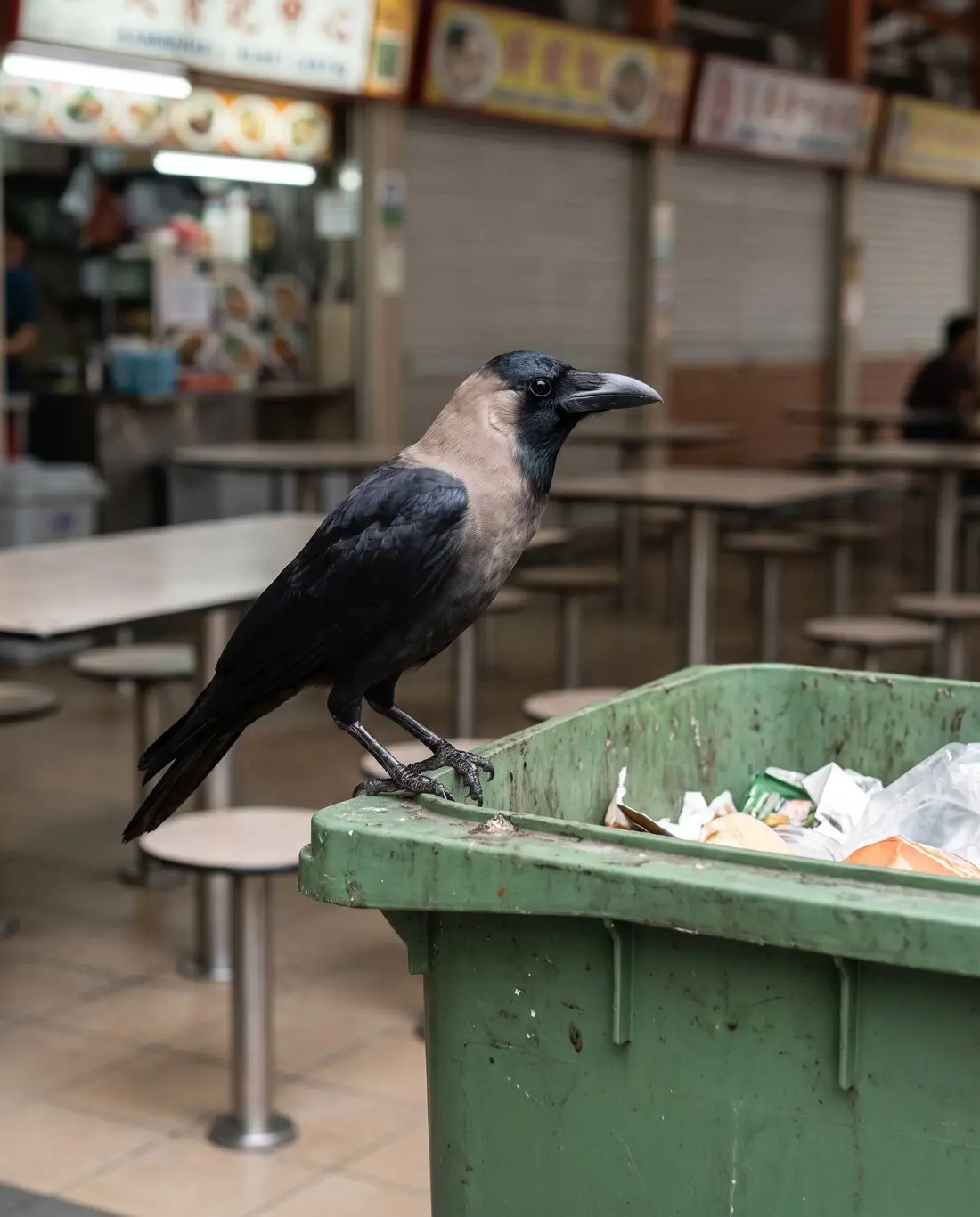
The house crow is the slim, grey-necked crow of Singapore's hawker centres and housing estates. It is not native. It arrived in the 1940s and grew from a few hundred birds in the 1960s to well over 100,000 by 2000. Smart, noisy and adaptable, it lives mostly on what people throw away.
How to recognise it
The house crow is about 40 to 43 cm long and slimmer than most crows. The forehead, crown, face, throat and upper breast are glossy black, while the neck and breast form a paler grey to grey-brown collar. The wings, tail, legs and bill are black. Its call is a harsh, flat kaaw-kaaw.
Singapore's native crow, the large-billed crow (Corvus macrorhynchos), is bigger and all black, with a heavy, arched bill and no grey collar.
Where it lives in Singapore
House crows live close to people, in housing estates, town centres, hawker centres and coastal areas. Research in Singapore found their numbers were closely tied to human food waste and were higher near the coast. They nest in large trees with big, dense crowns, and a Singapore study found the yellow flame tree was their favourite.
The first colony grew around Singapore's downtown port in the 1940s. The birds may have come as stowaways on ships from India or Sri Lanka. Another idea is that they spread south from Port Klang in Malaysia, where house crows were brought in around 1900 against a caterpillar plague on coffee estates. From a few hundred in the 1960s, the population reached an estimated 106,000 to 176,000 in 2000 to 2001. It fell sharply over the next decade, but numbers have risen strongly again in recent years.
What it eats
House crows eat almost anything. Much of their food comes from refuse around homes, hawker centres and bin centres. They also catch insects, lizards and small mammals, raid nests for eggs and chicks, and eat grain and fruit. Records in Singapore include fruit bats, toads, fish and the chicks of spotted doves.
Behaviour
House crows are social, noisy and intelligent, and tool use is well documented in this species. At dusk they gather in large communal roosts in tall, dense trees, often in bright, busy places near food. They often mob birds of prey and other large birds, and in the nesting season some defend their nest area by swooping at people walking below.
Life cycle
A pair builds a stick nest high in a tree and lays 3 to 5 pale blue-green eggs with brown speckles. Incubation takes about 16 to 17 days, and the chicks leave the nest at three to four weeks old. The Asian koel, a native cuckoo, lays its eggs in house crow nests and leaves the crows to raise its chicks.
Is it dangerous?
The house crow is rated GIVE SPACE (3 m). For most of the year it pays little attention to people. Near an active nest, a crow may dive at a person's head and sometimes strike with its feet. These attacks are a defence of the nest, not hunting. House crows carry no venom.
Frequently asked questions
Are house crows native to Singapore?
No. House crows are native to South Asia. The first Singapore colony grew around the downtown port in the 1940s. The population reached an estimated 106,000 to 176,000 birds by 2000 to 2001, fell sharply over the next decade, and has risen again in recent years.
Why do crows swoop at people?
House crows defend the area around their nests. During the nesting season, a crow may dive at people who walk close to the nest tree and sometimes strike with its feet.
How do you tell a house crow from a large-billed crow?
The house crow is slimmer, with a grey to grey-brown neck and breast. The native large-billed crow is bigger and all black, with a heavy, arched bill.
What is the link between the Asian koel and the house crow?
The Asian koel is a cuckoo that lays its eggs in house crow nests. The crows then incubate the eggs and raise the koel chicks as their own.