The feral pigeon is the grey pigeon of Singapore's void decks, hawker centres and building ledges. It descends from domestic pigeons that people kept for thousands of years and now lives on its own in cities around the world. Buildings suit it because its wild ancestor, the rock dove, nests on cliffs and in caves.
How to recognise it
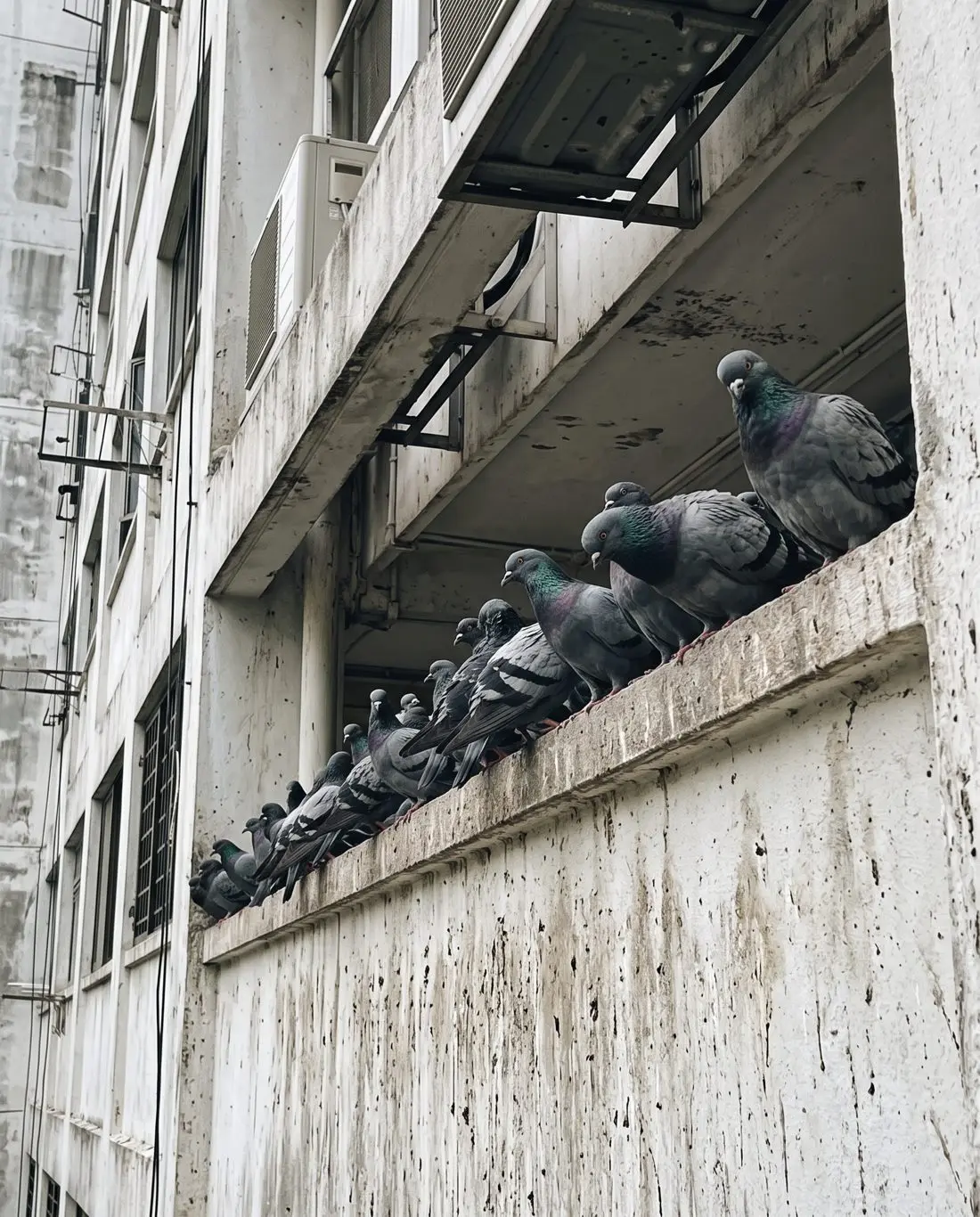
The classic feral pigeon is blue-grey with a darker head and a shiny green and purple sheen on the neck. Each wing has two black bars, and the tail has a dark band at the tip. The eyes are orange to red-brown and the feet are pink to red. It is 30 to 35 cm long, and males and females look alike.
Feral flocks vary a lot. Many include chequered, brown, reddish, white or almost black birds, a leftover from centuries of domestic breeding. When a flock circles overhead, the white undersides of the wings flash.
Where it lives in Singapore
Feral pigeons are found across built-up Singapore. They roost and nest on ledges, beams, air-conditioner ledges and rooftops of HDB blocks, car parks and other buildings, and feed in open areas nearby. Places with food scraps, such as hawker centres and open fields, often have big flocks.
A survey of Singapore's urban areas in 2010 to 2011 found the rock pigeon to be the second most numerous bird after the Javan myna.
What it eats
Pigeons are natural seed and grain eaters. In the city they also eat bread, rice and other scraps, and now and then small animals such as worms and insect larvae. They feed on the ground, usually in flocks.
Behaviour
Feral pigeons are social birds that spend the day in flocks. Pairs usually stay together. People domesticated the rock dove possibly as long as 5,000 years ago and used pigeons for carrying messages, for food and as pets. Escaped domestic birds are the origin of feral pigeons everywhere, including Singapore.
Life cycle
In Singapore's warm climate, feral pigeons can breed all year. A pair lays two white eggs on a ledge, and both parents take turns to sit on them for 17 to 19 days. For the first few days the chicks are fed crop milk, a rich food made in the lining of the parents' crop. The young fly at about 30 days old, and a pair can lay up to six times a year. Feral pigeons usually live 3 to 5 years.
Is it dangerous?
Feral pigeons are rated HARMLESS. They do not bite or attack people. The health concern is dried droppings that build up over time. These can carry fungi and bacteria, including those that cause cryptococcosis, histoplasmosis and psittacosis. Serious infection is uncommon, and people with weakened immune systems are most at risk.
Frequently asked questions
Are feral pigeons native to Singapore?
No. Feral pigeons descend from domestic pigeons, which were bred from the wild rock dove of Europe, North Africa and western Asia. They are an introduced species in Singapore.
Is a feral pigeon the same as a rock dove?
Yes, they are the same species, Columba livia. Rock dove usually means the wild form that nests on sea cliffs. Feral pigeons are descendants of domestic birds living on their own in towns.
How many eggs does a pigeon lay?
Two white eggs at a time. Both parents incubate them for 17 to 19 days, and a pair can nest up to six times a year.
Why are pigeons different colours?
Domestic pigeons were bred into many colours and patterns. Feral pigeons inherited this variety, so a flock can include grey, chequered, brown, white and dark birds.
Can pigeon droppings make you sick?
Large build-ups of dried droppings can carry fungi and bacteria that cause illnesses such as cryptococcosis and psittacosis. Serious infection is uncommon, and people with weakened immune systems are most at risk.