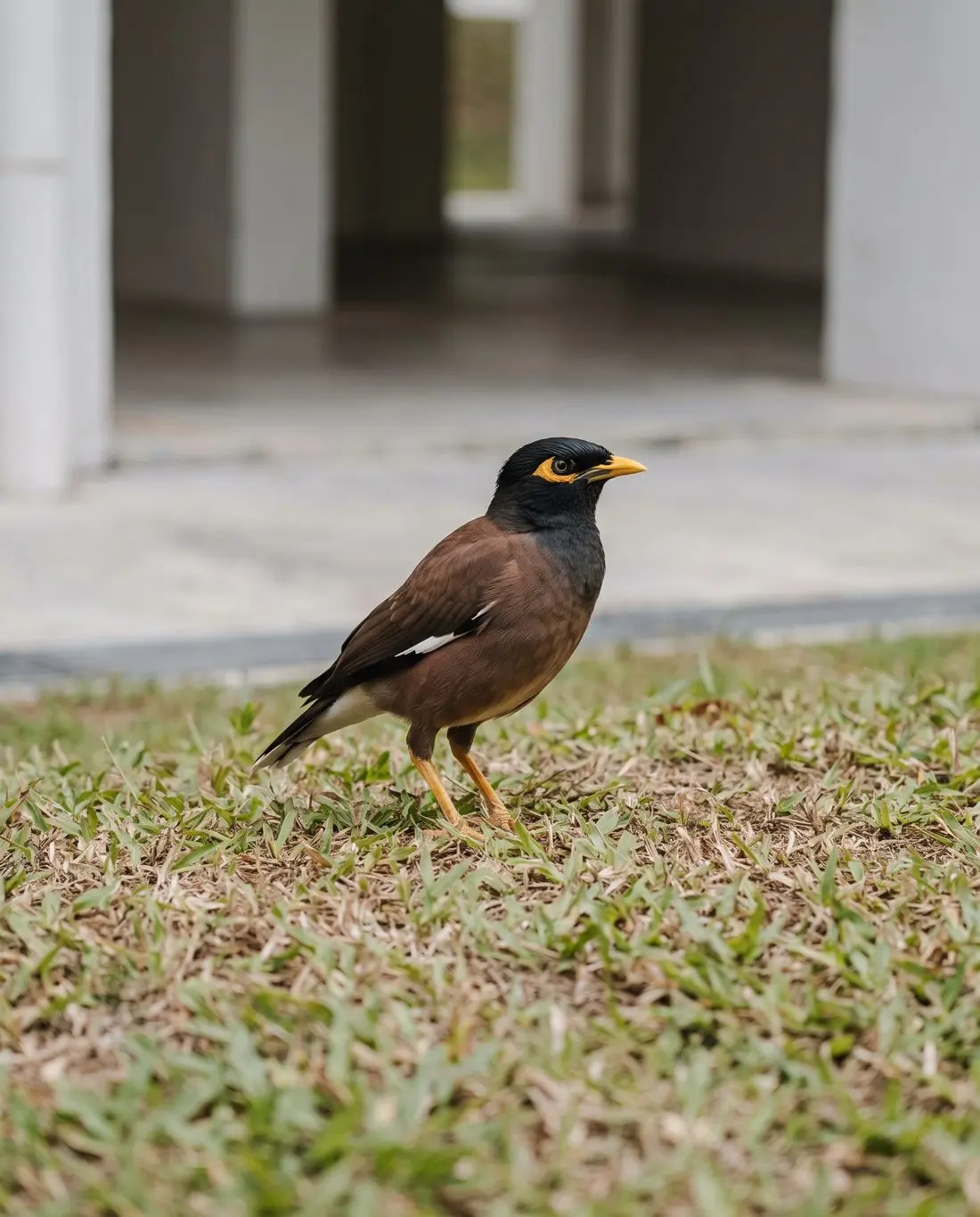
The common myna is the brown myna with a black head and a bright yellow patch of bare skin behind the eye. In Singapore it is now far outnumbered by the introduced Javan myna. Outside its native range it is one of only three birds on the IUCN list of the world's 100 worst invasive species.
How to recognise it
The common myna is 23 to 27 cm long, with a warm brown body and a glossy black head and neck. The bare skin behind the eye is bright yellow, and so are the bill and legs. In flight it shows large white wing patches, and the underside of the tail and the tail tip are white.
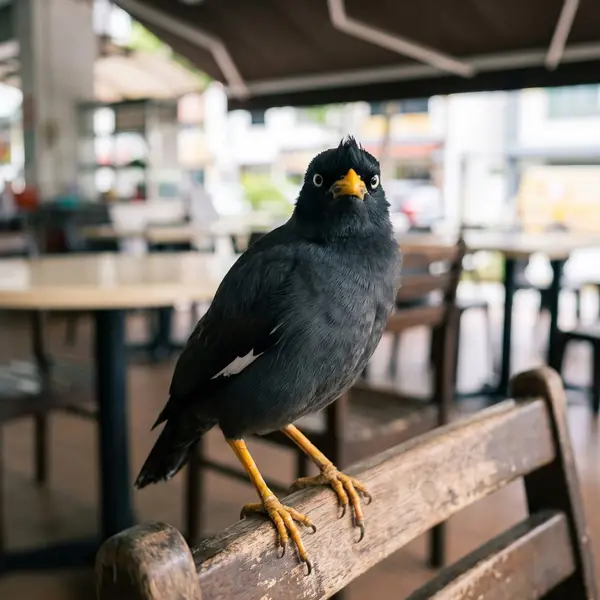
Males and females look alike, and young birds are duller and browner. The Javan myna is darker and greyer, has a forehead tuft and lacks the yellow eye patch.
Where it lives in Singapore
Common mynas prefer open, grassy places: fields, parks, gardens and the green edges of housing estates. Its native range runs from Iran and South Asia to mainland Southeast Asia. Local checklists treat it as native, though Singapore's birds probably have mixed origins, including escaped cage birds.
Its numbers have fallen. In 2000 to 2001 there were an estimated 20,000 to 29,000 common mynas in Singapore, against more than 120,000 Javan mynas. In surveys of Singapore's urban areas, it dropped significantly between 2000 to 2001 and 2010 to 2011. Competition with the Javan myna is often suggested, but that study could not find a direct link at the sites it surveyed.
What it eats
It is an omnivore that feeds mostly on the ground. Grasshoppers are a favourite, along with other insects, grubs, earthworms and spiders. It also eats seeds, grain, fruit, nectar and food scraps.
Behaviour
Common mynas are usually seen in pairs and are believed to pair for life. They sleep in communal roosts, which can hold from under a hundred to thousands of birds, and the flock calls together in a noisy chorus before settling. Their calls include croaks, squawks, clicks and whistles. Captive birds can learn to copy speech, which made them popular as cage birds.
Life cycle
Common mynas nest in holes in trees or walls, lining the nest with twigs, roots and even scraps of paper or foil. The female lays 4 to 6 pale blue-green eggs. Incubation takes 17 to 18 days and the young leave the nest at 22 to 24 days old. In parts of its range, the Asian koel, a cuckoo, sometimes lays its eggs in common myna nests.
Is it dangerous?
The common myna is rated HARMLESS. It does not attack people and has no venom. Its place on the world's worst invasive species list comes from its effect on native birds in countries where it was introduced, where it competes for nest holes and food.
Frequently asked questions
Is the common myna native to Singapore?
It is generally treated as native, as its natural range reaches into Southeast Asia. Singapore's birds probably have mixed origins, including escaped cage birds.
Why is the common myna on the world's worst invasive species list?
In countries where it was introduced, it spreads quickly and competes with native birds for nest holes and food. In 2000 the IUCN named it one of 100 of the World's Worst Invasive Alien Species, one of only three birds on the list.
Are common mynas rarer than Javan mynas in Singapore?
Yes. The Javan myna is now Singapore's most common bird, while common myna numbers fell significantly in urban surveys between 2000 and 2011.
Do common mynas mate for life?
They are believed to. Common mynas are usually seen in pairs, and pairs nest together in tree or wall holes.