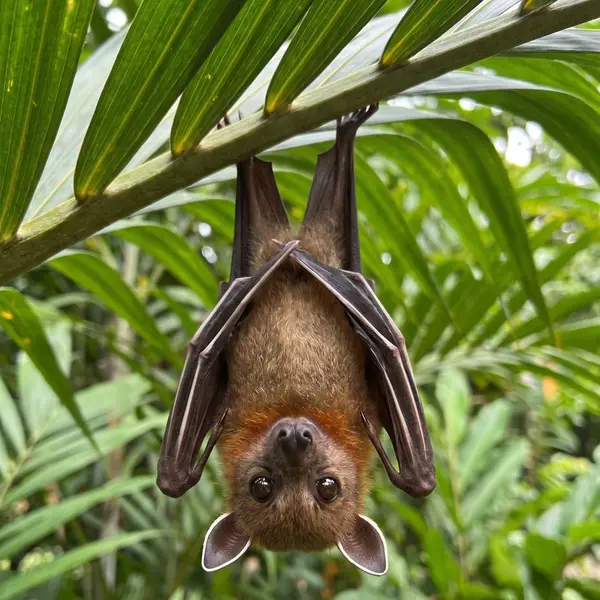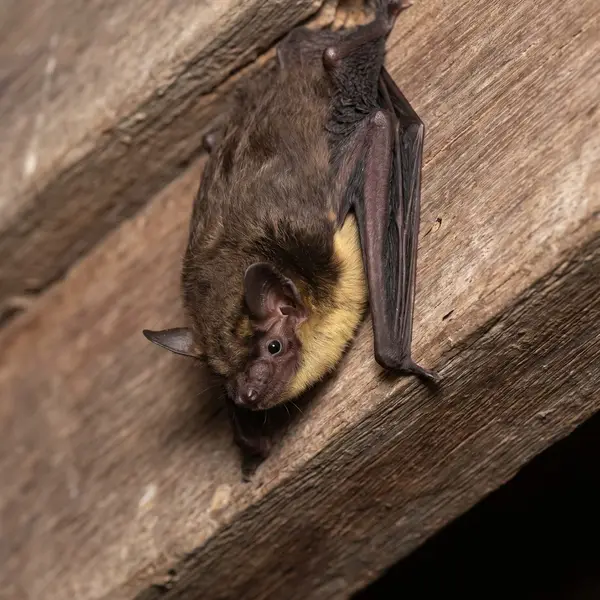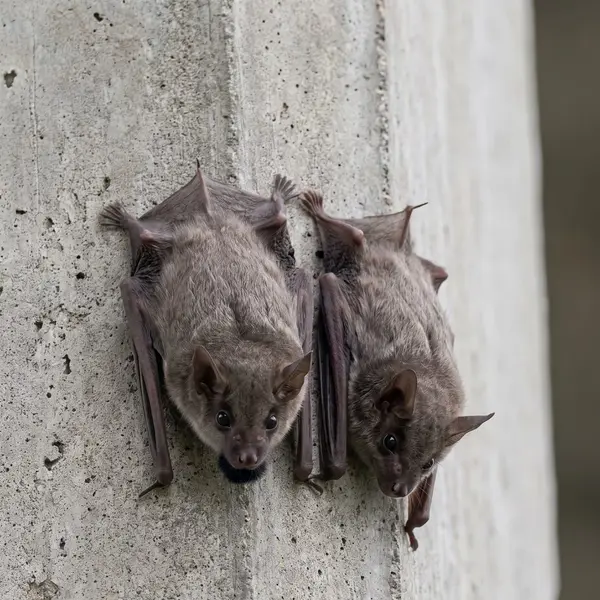
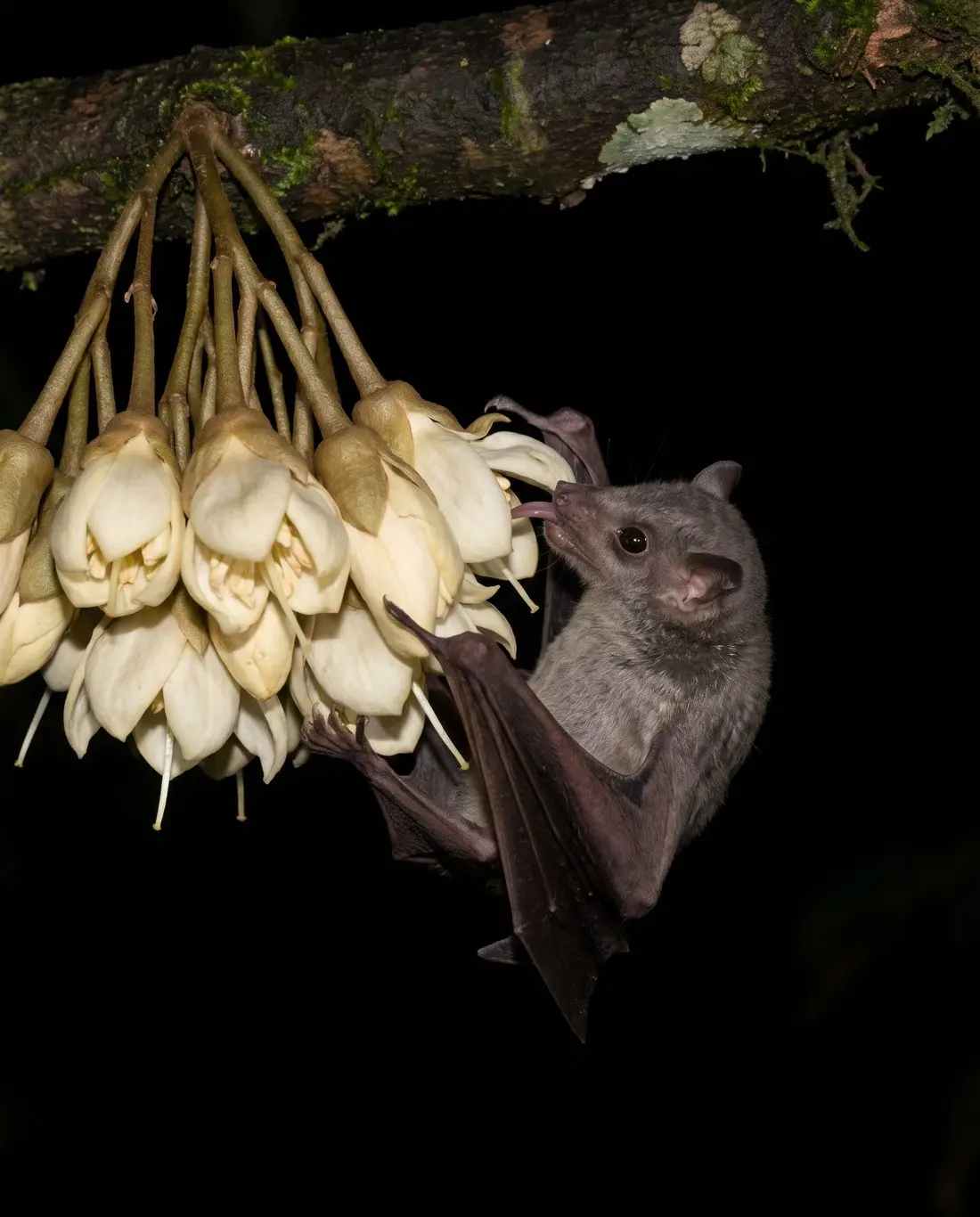
The cave nectar bat (Eonycteris spelaea) is a grey-brown fruit bat that drinks nectar instead of eating fruit. It is one of the most important pollinators in Southeast Asia and the main pollinator of durian. In Singapore it is uncommon, roosting under concrete flyovers near forest and flying out at night to flowering trees.
How to recognise it
This is a medium-sized fruit bat. Its head and body measure 8.5 to 11 cm and its forearm 6 to 7 cm. Adults usually weigh up to about 60 g, and males are larger than females.
The back is dark greyish brown and the underside is a paler grey. The fur on the neck can have a yellowish brown tinge, and males carry longer, darker scent hairs there. It has a long, narrow muzzle, large eyes, small simple ears and plain dark wings with no white markings. Its long tongue can reach deep into flowers.
Unlike most fruit bats, it has no claw on its second finger. It also has a short tail that is free of the membrane between its legs.
Where it lives in Singapore
It is native but uncommon here, and it is regarded as Vulnerable in Singapore. Across Southeast Asia it roosts on cave ceilings, sometimes in colonies of more than 50,000 bats. Singapore has few natural caves, so here it roosts mainly under concrete flyovers and bridges near forested areas. One local roost holds about 500 bats.
At night it flies out to flowering trees in forest edges, parks and along roads. It is sometimes seen feeding at flowering trees in housing estates too.
What it eats
It feeds on nectar and pollen, not fruit. In a year-long diet study in southern Thailand, petai made up about a third of its diet and banana more than a quarter. In March and April, when durian trees flower, durian made up about 40% of its diet.
Durian flowers open in the late afternoon and shed their pollen in the evening. They are visited mainly by this bat, which carries pollen from tree to tree as it feeds. Studies in Thailand and Malaysia show it is the chief pollinator of durian, and many durian trees cannot set fruit with their own pollen. In Singapore it has been recorded feeding at petai, golden penda and banana flowers.
Behaviour
It is a strong, long-distance flier. In Peninsular Malaysia, pollen in its diet suggested it was flying about 38 km to feed, and radio-tracking in Thailand found bats feeding up to 18 km from their roost. In Thailand, tracked bats used the same feeding areas for months and rested at night roosts in nearby trees between feeds.
Roosts are crowded and noisy, and males and females often hang in separate clusters. It finds flowers mainly by sight and smell. Experiments in Thailand showed that it can also make clicking sounds with its wings that work as a rough sonar in the dark.
Life cycle
Males are thought to mate with several females. Females can breed up to twice a year and usually have a single pup. The pup clings to its mother, even while she flies, for the first 4 to 6 weeks and is weaned at about three months. Females can breed from 6 to 12 months old, while males take one to two years to mature.
Is it dangerous?
It does not attack people and spends its nights at flowers, usually high in trees. Like any wild bat, it may bite if it is grabbed or handled. Singapore has been free of rabies since 1953, and no bat here has been found with rabies.
Frequently asked questions
Which bat pollinates durian?
The cave nectar bat. Durian flowers open in the late afternoon, and studies in Thailand and Malaysia show this bat is their main pollinator, carrying pollen from tree to tree as it drinks nectar.
Where do cave nectar bats live in Singapore?
Singapore has few natural caves, so here they roost mainly under concrete flyovers and bridges near forest. They fly out at night to flowering trees in parks, along roads and at forest edges.
Is the cave nectar bat rare in Singapore?
Yes. It is native but uncommon to rare here and is regarded as Vulnerable locally. Globally it is listed as Least Concern, though its population is thought to be declining.
Does the cave nectar bat eat fruit?
No. Despite being a fruit bat, it feeds on nectar and pollen from flowers such as durian, petai, banana and golden penda.
How far does a cave nectar bat fly to feed?
Radio-tracking in Thailand found bats feeding up to 18 km from their roost, and a diet study in Peninsular Malaysia suggested flights of about 38 km.