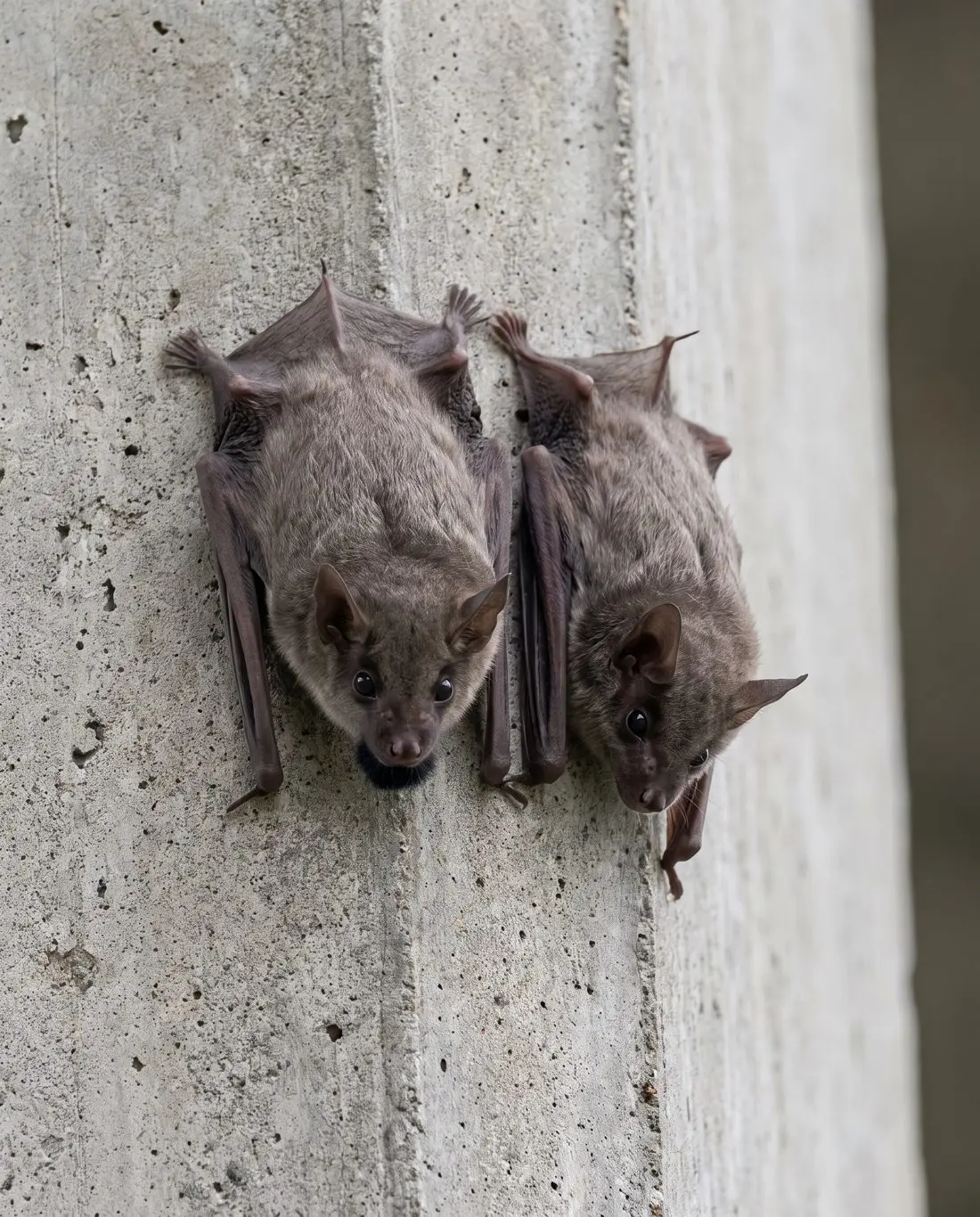
The black-bearded tomb bat (Taphozous melanopogon) is a slim, fast-flying insect bat named for the dark tuft of fur under the chin of adult males. Unlike most bats, it often roosts out in the open on walls and rock faces. It is widespread but rare in Singapore, with roosts in both forest and the city.
How to recognise it
Tomb bats are slim insect bats with long, narrow wings built for fast, direct flight. The black-bearded tomb bat has a forearm of 5.5 to 6.8 cm and weighs about 25 to 30 g.
The fur is grey-brown to buff-brown above and paler, sometimes almost white, below. The face is pointed and the eyes are large and dark, much bigger than in most insect bats. Adult males usually have a patch of black fur under the chin, the beard that gives the species its name. The beard develops at around six months of age.
The chin is furred and there is no throat pouch. In flight the pale wings can look whitish. The slender tail pokes out from the middle of the membrane between the legs, a feature of the sheath-tailed bat family it belongs to.
Where it lives in Singapore
It is native and widespread, but rare, and it is listed as Endangered in the Singapore Red Data Book (2008). Its distinctive calls are picked up by bat detectors in many parts of the island, and it has been photographed hunting at dusk near Bukit Brown.
Elsewhere in Asia it roosts in caves, rock crevices, temples, ruins and old buildings. In Singapore it roosts on open walls and large boulders in forest, and also in the city. Known roosts have included a basement near Orchard Road and a high-rise building in the city. It sometimes shares roosts with the white-winged tomb bat, which is usually present in far larger numbers.
What it eats
It eats moths and other flying insects. It hunts in open air, often just above the forest canopy and along forest edges at dusk. Its long, narrow wings suit fast flight in open spaces rather than twisting among branches.
Behaviour
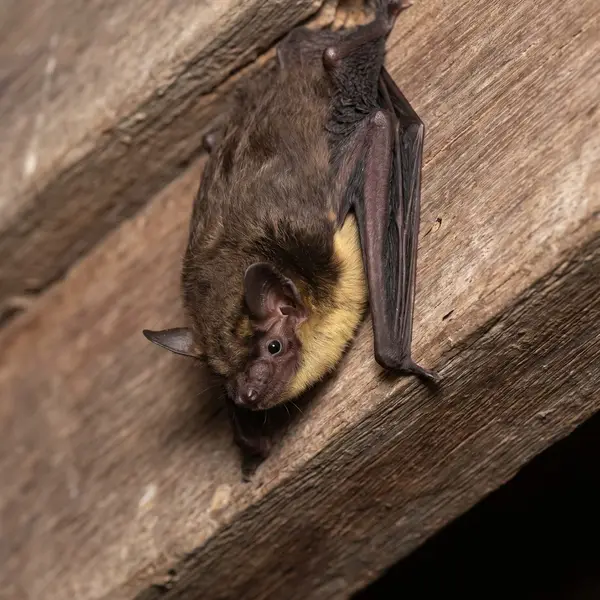
It often roosts on the open surface of a wall or rock rather than tucked inside a crack. At rest it props itself up on its wrists, keeping its body slightly off the surface.
It is a colonial bat. Roosts of up to 15,000 have been recorded in India and colonies of up to 4,000 in Thailand. Males and females often roost apart or in different parts of a colony. Its echolocation calls are long, with several harmonics.
Life cycle
It breeds seasonally. Pregnancy lasts about 120 to 125 days, and a female usually has a single pup, although twins have been recorded. Newborns weigh about 7 to 8 g, roughly a quarter of their mother's weight.
Is it dangerous?
It does not attack people and usually roosts high on walls, well out of reach. Like any wild bat, it may bite if it is grabbed or handled. Singapore has been free of rabies since 1953, and no bat here has been found with rabies.
Frequently asked questions
Why is it called a tomb bat?
The genus name Taphozous comes from Greek words meaning tomb and living. Bats in this group often roost in old tombs, temples, ruins and caves.
Do all black-bearded tomb bats have a beard?
No. The black tuft of fur under the chin is mainly seen on adult males, and it develops at around six months of age.
Where does the black-bearded tomb bat live in Singapore?
It roosts on open walls and large boulders in forest, and on buildings in the city, including a basement and a high-rise building. It hunts at dusk over forest edges and open areas.
Is the black-bearded tomb bat rare in Singapore?
Yes. It is native and widespread but rare, and it is listed as Endangered in the Singapore Red Data Book (2008). Globally it is listed as Least Concern.
Is the black-bearded tomb bat dangerous?
No. It does not attack people and bites only if handled. Singapore has been rabies-free since 1953.