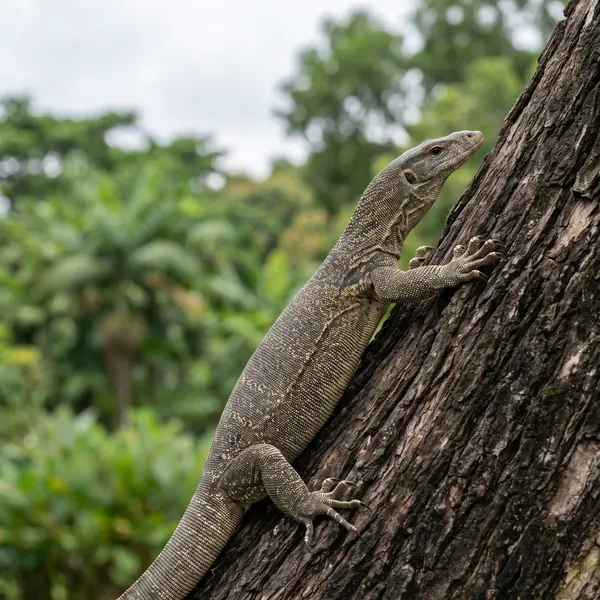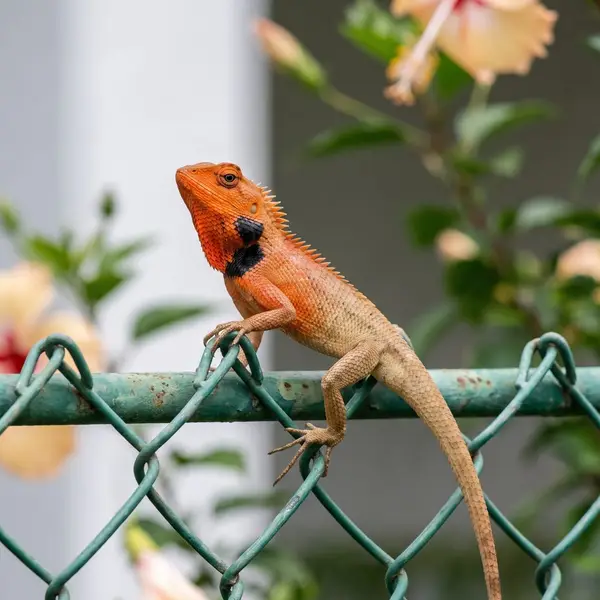
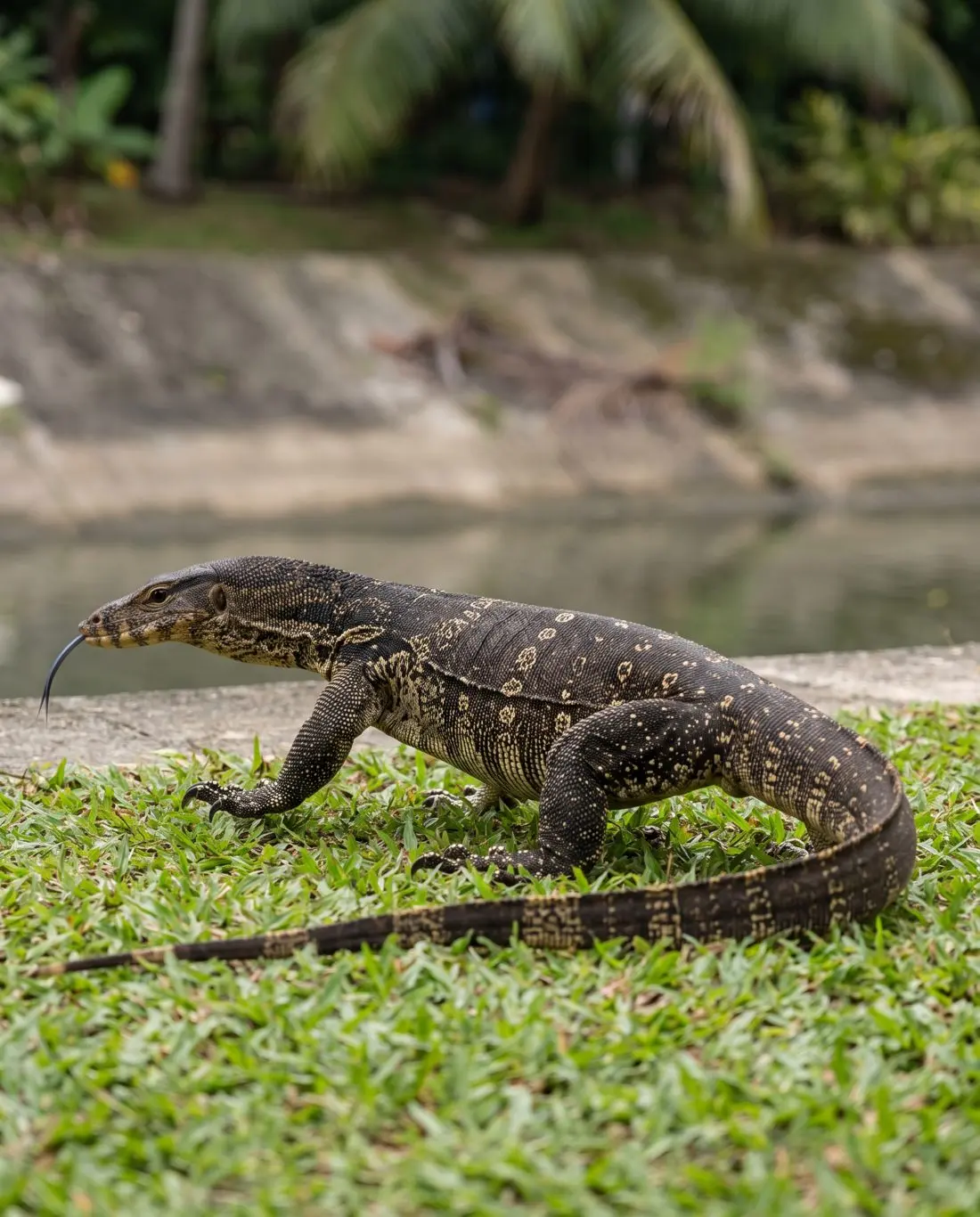
The Malayan water monitor is Singapore's biggest lizard and the one people see most often. It is a strong swimmer that lives wherever there is water, from mangroves to concrete canals. Despite its size, it is shy and usually moves off when people come near.
How to recognise it
Adults are dark brown to black with small pale yellow spots and lighter bands across the tail. The head and neck are long, and the tail is flattened from side to side like a paddle. The nostrils sit close to the tip of the snout. This is the easiest way to tell it from the clouded monitor, whose nostrils are halfway up the snout.
Young water monitors look very different. They are black with neat rows of bright yellow spots, and this pattern fades as they grow. Most adults are under 2 m long, tail included, and the very largest reach about 3 m.
Where it lives in Singapore
Water monitors live in almost every habitat near water: mangroves, freshwater ponds, reservoirs, rivers, canals and large drains. They are common in parks and gardens, and regularly turn up on lawns, footpaths and pool decks next to water.
A study at Sungei Buloh Wetland Reserve counted about 3.9 monitors per hectare. Radio-tracked lizards there had small, overlapping home ranges and used trees and burrows as their base. They used freshwater ponds and mangroves more than brackish ponds.
What it eats
It is a hunter and a scavenger. At Sungei Buloh, crabs were the most common prey, followed by fish, insects and small mammals. Crabs and fish together made up more than 60% of the food by volume, and bigger monitors took bigger prey.
Records from around Singapore also include snakes such as the dog-faced water snake, changeable lizards, frogs, turtles, birds and even a smooth otter pup. It readily eats dead animals and food waste. It finds food with its forked tongue, which picks up scent from the air and ground.
Behaviour
Water monitors are active by day and spend a lot of time basking. They swim well, pushing through the water with the tail, and can stay underwater for long periods. Adults spend most of their time on the ground and in water. Young ones climb more and often sleep in trees, away from predators.
When disturbed, a monitor usually heads for water or a drain. If it is cornered, it raises its neck, puffs out its throat, hisses loudly and may lash its tail.
Life cycle
In Singapore, water monitors breed all year, with more egg-carrying females in the wetter months from October to March. At Sungei Buloh, females dug nests about 27 cm deep and preferred sandy soil. Clutches averaged 13 eggs, with a range of 5 to 25, and bigger females laid more.
The eggs take about seven months to hatch. Hatchlings are on their own from the start, with a body about 13.5 cm long, not counting the tail. Water monitors have lived 11 to 25 years in captivity, and most live shorter lives outside it.
Is it dangerous?
The water monitor is rated GIVE SPACE (3 m). It does not hunt people and bites are uncommon. They happen when a monitor is cornered, grabbed or trapped. Its teeth are serrated, its claws are sharp and the tail can whip hard. Monitor lizards have a mild venom that is not a danger to people. The main risk from a bite is infection.
Frequently asked questions
Are water monitors dangerous to people?
Not usually. They are shy and avoid people. A cornered or handled monitor can bite, scratch or whip its tail. Its venom is mild and not a danger to people. Infection is the main risk from a bite.
How big do water monitors get in Singapore?
Most adults are under 2 m long including the tail. The very largest reach about 3 m. Hatchlings have a body of about 13.5 cm, not counting the tail.
How do you tell a water monitor from a clouded monitor?
Look at the nose and tail. A water monitor's nostrils are near the tip of the snout and its tail is flattened like a paddle. A clouded monitor's nostrils are halfway between the eye and the snout tip, and its tail is rounder. The clouded monitor is also greyer and lives mainly in forest.
What do baby water monitors look like?
Hatchlings are black with rows of bright yellow spots. The colours fade as they grow. Young monitors spend more time in trees than adults do.
What do water monitors eat?
Mostly crabs and fish. They also eat insects, snakes, lizards, frogs, birds, rodents and turtles, and they scavenge dead animals and food waste.