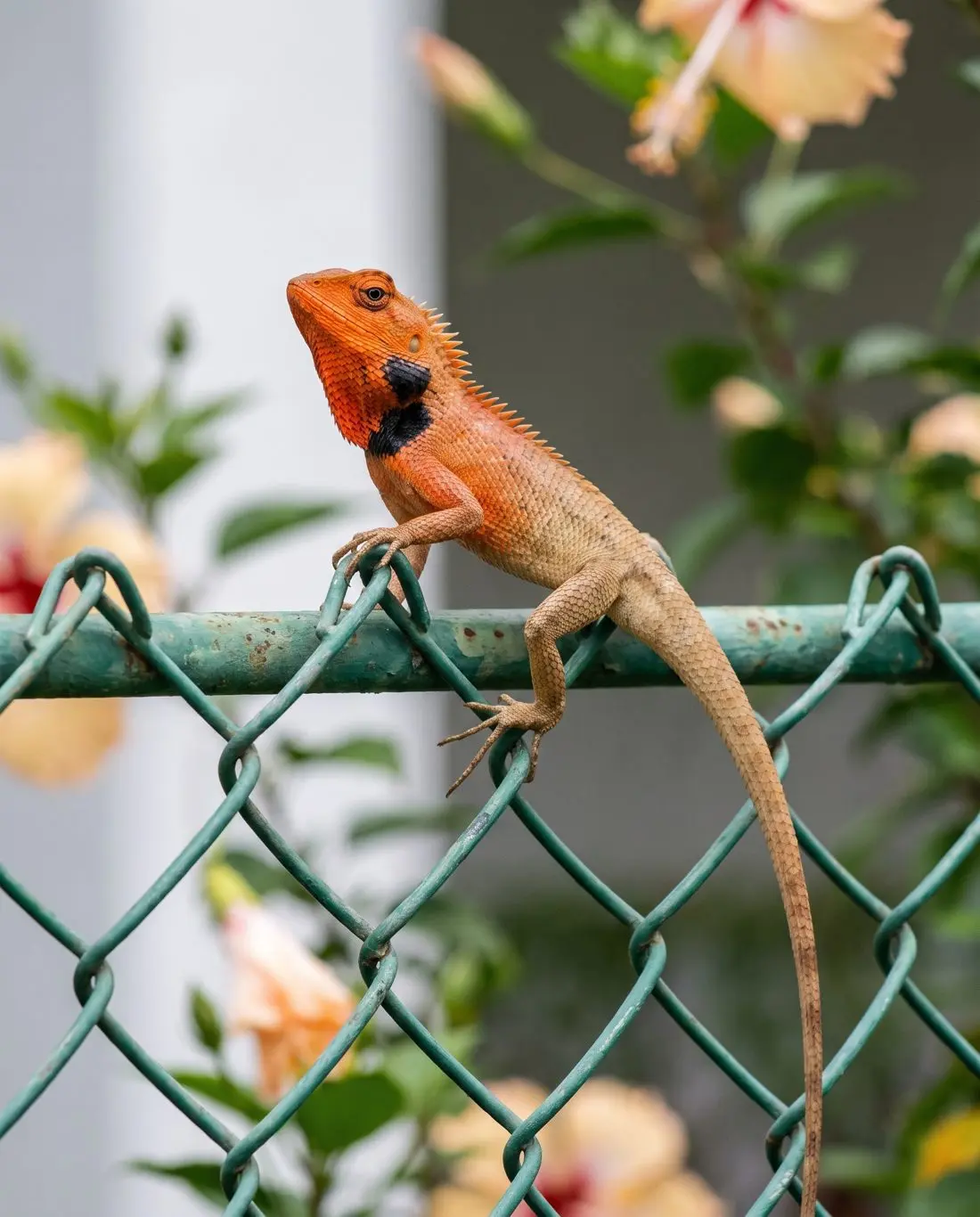
The changeable lizard is the spiky brown lizard seen sunning on fences and hedges all over Singapore. It is not native. It arrived in the early 1980s and is now found across the island. Breeding males are easy to spot with their bright orange-red heads.
How to recognise it
It is a slim lizard with a crest of spines along the neck and back, small spines above each ear and a very long, thin tail. Most of the time it is light brown or olive-grey with darker bands. It is not a chameleon, but it can darken or brighten its colours, which is how it got its name.
Breeding males turn bright orange to red on the head and shoulders, with black patches on the throat. Adults have a body of up to about 10 cm, and with the tail they reach about 37 cm.
Recent DNA studies show that the name Calotes versicolor covers several look-alike species. Singapore's lizards are still listed under this name, but which species they belong to is being studied.
Where it lives in Singapore
Changeable lizards live in gardens, parks, hedges, grass verges and at the edges of secondary forest. They are common on fences, low shrubs and tree trunks in housing estates, but are not found deep inside mature forest.
No lizards of this group were recorded in Singapore before the early 1980s. By the mid 1980s they were established, probably after arriving by accident by rail or ship from northern Peninsular Malaysia or Thailand. Since then the native green crested lizard (Bronchocela cristatella) has largely disappeared from gardens and parks. Scientists think the newcomer may have played a part, though this is not proven.
What it eats
It feeds mainly on insects such as ants, beetles, grasshoppers and dragonflies, and now and then on smaller lizards. It waits on a perch, dashes out to grab its prey and may shake it before swallowing it whole.
Behaviour
Changeable lizards are active by day and often bask in the open. Breeding males guard territories and show off to rivals and females with push-ups and a puffed-out throat. When disturbed, one will dart up a tree and slip round to the far side of the trunk. Unlike geckos and skinks, it does not drop its tail.
Life cycle
Females lay clutches of about 5 to 20 eggs. The eggs are buried in moist soil or laid in small holes, and hatch after about six to nine weeks. Young lizards can breed at about one year old. In Singapore, Kopstein's bronzebacks and Malayan water monitors have both been recorded eating them.
Is it dangerous?
The changeable lizard is rated HARMLESS. It has no venom and does not attack people. Where its old South Asian nickname, bloodsucker, came from is unclear. It is usually linked to the red colouring of breeding males. It does not suck blood. It may give a small nip if handled, but it cannot do real harm.
Frequently asked questions
Is the changeable lizard native to Singapore?
No. It was first recorded in the early 1980s and was established by the mid 1980s, probably after arriving by accident from further north. It is now one of the most common lizards in Singapore's gardens and parks.
Is the changeable lizard a chameleon?
No. It belongs to the agamid family, not the chameleons. It can darken or brighten its colours, which is where the name changeable comes from.
Why do some changeable lizards have red heads?
Those are breeding males. Their head and shoulders turn orange to red, with black throat patches, to attract females and warn off rival males.
Is the changeable lizard poisonous or dangerous?
No. It has no venom and does not attack people. It is rated HARMLESS.