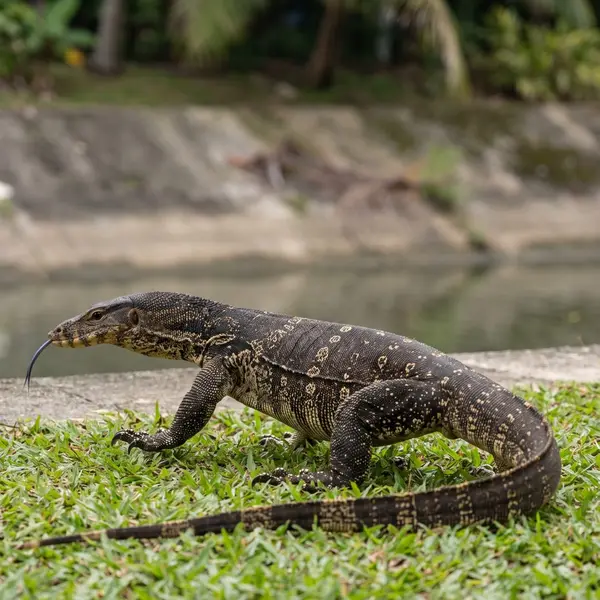
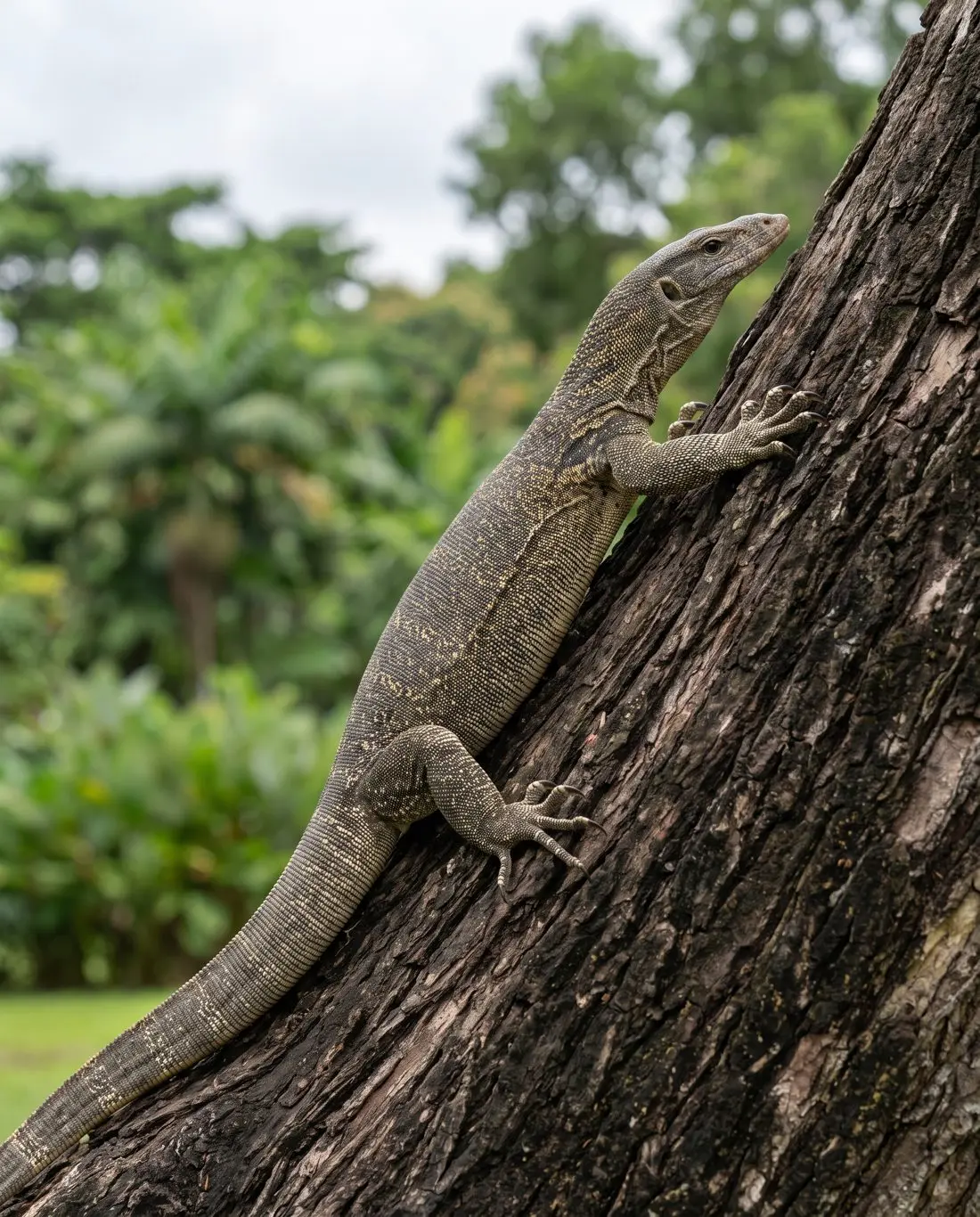
The clouded monitor is Singapore's forest monitor lizard. It is smaller and greyer than the Malayan water monitor and is far less tied to water. Most of its day is spent climbing trees or digging through leaf litter for insects.
How to recognise it
The clouded monitor is grey-brown with fine yellow speckles, which give it a cloudy look. Compared with the water monitor, its head is shorter and its tail is rounder, not flattened like a paddle.
The surest sign is the nose. The nostrils sit about halfway between the eye and the tip of the snout, while a water monitor's are right at the tip. The body reaches about 60 cm, and with the tail the biggest reach about 1.5 m, though few grow that large.
Where it lives in Singapore
It prefers forest and scrub. Most records come from the centre of the island, in and around Bukit Timah Nature Reserve, the Central Catchment forests and Bukit Batok Nature Park, as well as Pulau Ubin and Pulau Tekong. It was first documented in the Singapore Botanic Gardens in 2013 and has been seen there since, including along the Rainforest Trail.
It also turns up in smaller green patches such as Bukit Brown, Clementi Woods and Dairy Farm Nature Park. In December 2021, one was recorded basking in the grounds of the former Jurong Bird Park, which appears to be the first record from the south-west of the island.
What it eats
Clouded monitors feed mainly on invertebrates. They are usually seen nosing through leaf litter and digging for beetles, other insects and worms. They also take snakes and other small vertebrates when they can, while young clouded monitors feed largely on insects.
Behaviour
This is an excellent climber with strong, curved claws. It is often seen high on tree trunks or poking into tree holes. In March 2023, an observer at the Botanic Gardens watched four young clouded monitors basking beside tree holes 10 m or more above the ground, where they had probably spent the night.
Adults live alone and are active by day. They forage mostly on the ground but climb readily. In Singapore, clouded monitors are eaten by reticulated pythons and king cobras (Ophiophagus bungarus).
Life cycle
Like all monitor lizards, it lays eggs, and the young look after themselves from hatching. Young clouded monitors live more in the trees than adults do and are sometimes found in small groups, which may help them avoid predators. Its breeding habits in Singapore have not been studied in detail.
Numbers have fallen sharply in parts of Southeast Asia outside Malaysia. It is listed on CITES Appendix I, which strictly limits international trade.
Is it dangerous?
The clouded monitor is rated GIVE SPACE (3 m). It is timid and usually climbs or runs off. A cornered or handled clouded monitor may bite or scratch. Its venom is mild and not a danger to people, but bites can become infected.
Frequently asked questions
What is the difference between a clouded monitor and a water monitor?
The clouded monitor is greyer with fine yellow speckles, has a shorter head and a rounder tail, and its nostrils sit halfway up the snout. The water monitor is darker, has a paddle-like tail and nostrils near the snout tip, and lives near water.
Where can you see clouded monitors in Singapore?
Mainly in central Singapore: Bukit Timah Nature Reserve, the Central Catchment forests around MacRitchie, Bukit Batok Nature Park and the Singapore Botanic Gardens, plus Pulau Ubin. They are often seen on tree trunks.
Do clouded monitors live in trees?
Partly. They are excellent climbers and use tree holes as shelters, but adults also spend much time on the ground digging for insects. Young ones are the most tree-dwelling.
Is the clouded monitor endangered?
It is fairly common in Singapore's forests. It is on CITES Appendix I. On the IUCN Red List it is currently assessed as part of the Bengal monitor, listed as Near Threatened in 2021 because of declines in parts of its range.